Website: Carmel Clay Library
Archive
9,692 entries: 92 from X, 8,929 from Pinboard, saved 1998 to 2026.
Browse by tag, site, author, folder or language
Tags
- #python 399
- #programming 344
- #tutorial 187
- #books 176
- #javascript 154
- #webdesign 147
- #mathematics 131
- #blog 128
- #css 123
- #linux 122
- #reference 107
- #lisp 101
- #history 97
- #free 96
- #llm 96
- #productivity 96
- #business 95
- #design 91
- #statistics 90
- #opensource 87
- #gtd 83
- #r 80
- #lifehacks 78
- #ajax 77
- #graphics 77
- #visualization 77
- #datamining 75
- #typography 75
- #funny 74
- #photography 73
- #ai 68
- #machine-learning 68
- #algorithms 64
- #plone 64
- #kannada 63
- #database 62
- #india 59
- #education 58
- #learning 56
- #postgresql 56
Sites
- youtube.com 267
- github.com 233
- news.ycombinator.com 225
- en.wikipedia.org 161
- reddit.com 97
- x.com 82
- nytimes.com 70
- medium.com 69
- amazon.com 68
- arxiv.org 35
- code.google.com 34
- archive.org 28
- groups.google.com 28
- wired.com 27
- theatlantic.com 24
- theguardian.com 24
- bloomberg.com 21
- newyorker.com 21
- stackoverflow.com 21
- wsj.com 21
- en.m.wikipedia.org 19
- bbc.com 18
- plone.org 18
- btbytes.com 16
- btbytes.github.io 16
- old.reddit.com 16
- washingtonpost.com 16
- artima.com 15
- google.com 15
- thehindu.com 15
- onlamp.com 14
- www-128.ibm.com 14
- aws.amazon.com 13
- cs.cmu.edu 13
- economist.com 13
- atlasobscura.com 12
- informit.com 12
- smashingmagazine.com 12
- thriftbooks.com 12
- docs.google.com 11
Authors
- @simonw 19
- @ivanfioravanti 4
- @pratikg 2
- @ShriramKMurthi 2
- @__oQuery 1
- @achumukundan00 1
- @antoniogm 1
- @bhutanisanyam1 1
- @binsquares 1
- @BrankoMilan 1
- @Chris_arnade 1
- @code_star 1
- @coreyganim 1
- @DeepknowledgeU 1
- @dhh 1
- @dillon_mulroy 1
- @DODOREACH 1
- @ElamBend 1
- @elisa_freschi 1
- @emollick 1
- @EmreSevinc 1
- @fayazara 1
- @foxyjackfox 1
- @francoisfleuret 1
- @FrankYouChill 1
- @gabrielpeyre 1
- @GunduHuDuGa 1
- @hamsanandi 1
- @HistoryinStory 1
- @itometeam 1
- @karrisaarinen 1
- @KathaaChitram 1
- @kaushikcbasu 1
- @KirkDBorne 1
- @kmadathil 1
- @mertcemri 1
- @MistralAI 1
- @mprestonmeyer 1
- @nateliason 1
- @NousResearch 1
Folders
- notes 548
- Liked on YouTube 19
- ThriftBooks wish list 12
- indian-classical 4
- LLM 4
- GenAI-LLM 3
- Devotional 2
- Lectures 2
- Books 1
- C++ 1
- Indian Philosophy 1
- Inspirational 1
- Kaas 1
- Kannada 1
- Local Coding Agents 1
- Math 1
- Ollyver 1
- Programming 1
- Project Ideas 1
- Rust 1
- Sales 1
- Self Hosting 1
- Synthwave and Chill 1
- Watch Later 1
- Watches 1
- World Music 1
- Yoga 1
Languages
Tags and folders
Showing 3,951–4,000 of 9,692
2020
Untitled (https://writingcooperative.com/zettelkasten-how-one-german-scholar-was-so-freakishly-productive-997e4e0ca125)
writingcooperative.com
Did Zettelkasten method () have any influence on the development of @RoamResearch ?
Did Zettelkasten method () have any influence on the development of @RoamResearch ?
PC Engines home
pcengines.ch
MFW when trying to connect VGA connector to a serial bus port on the board. (attempting to…
MFW when trying to connect VGA connector to a serial bus port on the board. (attempting to…
Interesting Websites
Trying to collect websites that are intersting, free-standing, with a bit (or a lot) of personality. Preference given to "hand-made" websites. And to do so, all you may need is HTML.
The art of building "personal" websites is a thing of the 90s, it appears.. (See also the idea of IndieWeb).
Why have a personal website?
- Joe Roberts
- For What It's Worth [Offline]
- George Hart
- Peter Norvig -- needs no introduction for anyone familiar with computer science.
- Dubno.com -- a family website.
- Mark Irons’ Home Page -- a huge inspiration for this page. I made a note of his passing here.
- Zuckershack -- friend of MLI mentioned above.
- Boston
- kirk.is|archive by month
- HomePage for Brian Harvey (bh at cs.Berkeley.EDU) author of Simply Scheme: Introducing Computer Science
- https://blog.plover.com/
- http://www.thattommyhall.com/ creator of SICP distilled. also see his "101 Goals in 1001 days" project.
- Patterns — Gordon Brander
- Thorsten Ball -- good frontpage for developer
- Laurence Tratt -- good frontpage for developer
- The Murgia Hack System -- good use of simple, multiple column layout.
- Jason Goldstein | Developer uses Matthew Butterick's Equity Text typeface for body. nice.
- Jordan Vincent | UX Designer & Software Engineer
- kevinlynagh.com -- very readable, text first website design.
- Gwern.net -- in depth articles. in his own words -- "psychology, statistics, and technology; I am best known for my writings on the darknet markets & Bitcoin, blinded self-experiments & Quantified Self analyses, dual n-back & spaced repetition ... ". Built using Hakyll.
- Dan Luu in depth articles on hardware and software engineering. (eg: Do programmers need math?, HN: the good parts)
- byuu | byuu.net -- game emulator resources.
- ~hl -- “an online dustbin where you leave your collected written thoughts” — someone describing this website. Programming and stuff. Arrived there via XML is almost always misused.
- Jeff Kaufman
- Fabulous Text Only Websites, 2018 Edition
- Peter Schaffter; the creator of mom groff macros.
- Evan Jones - Software Engineer | Computer Scientist
- Minid.net – Diego Martin Lafuente's personal website & blog
- Cal Paterson, programming essays. See How a SQL database works.
- Kragen Javier Sitaker’s home page -- programmer, long essay writer. Worked with him for short duration (few emails?) in 2008, when I was working for Aaron Swartz.
- John Salvatier ai and machine learning researcher. See: Reality has a surprising amount of detail
- Simplifier -- diy website. plenty of projects on the homepage. hosted on neocities. really cool. This is one of the best examples of a "High Signal/ Low Ceremony" websites you can find. Even the webpages appear to be written "by hand". Amazing. The fact that the creator did not even put a name on it makes it even more impressive.
- Piero Scaruffi's knowledge base; over 6000 colorful pages. whew.
- JMNCO Home Page (Flounder)
- Org-mode, Emacs, and Getting Things Done hand built site of various stuff. search for his root of the website http://members.optusnet.com.au/~charles57/ in google to see more pages. the root of his website shows a default page.
- Tom Murphy 7's Invincible Web Page -- CS person. Interesting '90s looking design. programming languages, games, art stuff.
- Codex 99 -- about art, design and history
- Words and buttons online — a growing collection of interactive tutorials, demos, and quizzes about maths, algorithms, and programming.
- Graham Duncan -- via david_perell; see also Miikka Koskinen, which has long been an inspiration for this site. I am yet to incorporate the "portfolio" aspects of either site.
- Dmitry.GR -- electronics projects.
- Beyond the Frame -- development blog, clojure etc. uses Tufte CSS, pleasing design.
- A Universe of Sorts -- math, chapellang, and clojure blog.
- Developer Roadmaps - roadmap.sh
- Felix' Blog #programming #blog
- Arne Bahlo #programming #blog
- Beej's Web Page, Brian "Beej Jorgensen" Hall, creator of many popular networking, and programming guides. He is using pandoc for his newer books.
- ajkprojects of asnewman
- ~hl/Hugo Landau - “an online dustbin where you leave your collected written thoughts” — someone describing this website
- Chip Huyen; well put together front page and an informative website. An excellent personal website.
- John Jacobson -- programming and visual arts.
- josh avanier - code, photos, draw, generative art.
- XXIIVV — about -- another member? of the 100 rabbits collective found via avanier's page
- Brad Woods Digital Garden -- Notes about creative coding on the Web; see 7GUIs
- Interactive Storytelling Tools for Writers | Chris Crawford "This website has been in operation since 1996. It is older than Google, Netflix, Facebook, and Amazon. It still runs on a server using vacuum tubes."
- LukeW Ideation + Design | Digital Product Strategy & Design, esp AI related
- Ordinary Abundance -- Edward Bellamy once imagined that music on demand would be "the limit of human felicity." A modern apartment is full of things that once drew the same kind of awe.
Meta
- Tiny Awards "a small prize to celebrate interesting, small, craft-y internet projects and spaces which basically make the web a more fun place to be."
- Sumit Khanna -- A History of Personal and Professional Websites -- nice recollection of his websites '90s to now.
- Show your personal websites | Lobsters Jan 2020. Interesting collection of websites, mostly static (expected, considering its a lobste.rs user).
- HN
- www.marginalia.nu @ marginalia.nu -- search engine (" DIY search engine that focuses on non-commercial content, and attempts to show you sites you perhaps weren't aware of in favor of the sort of sites you probably already knew existed."), encyclopedia("This is a what-if experiment in web design: What if we designed web-sites according to print principles, an experiment in web design, a high-readability, low-distraction encyclopedia with design choices such as narrow column widths, high line-spacing and a consistent typeface."), website explorer("This is a game where you explore more or less random and obscure websites around the Internet, based on the database of the Marginalia Search Engine.")
- twitter thread "Reply with a link to the best web dev portfolio you've seen"
- Webring by Avanier; see also applianceri.ng - Appliance Ring
- What to keep in mind while making websites -- Rediscovering the Small Web - Neustadt.fr by Parimal Satyal.
- Protoweb -- a community-driven public service that hosts historical Internet websites to demonstrate the Internet in its early days. Its goal is to rebuild and restore early Internet services to offer a seamless browsing experience.
- neugierig.org, site of Evan Martin, who blogs about programming and technical topics ( Chrome, Jujutsu etc.,)
- Aman Bhargava (amah.bh) form Bengaluru; blogs on design, data and code. See How Bangalore Uses The Metro
Related
- Search engine for searching people’s personal websites: https://wiby.me/
- Text-only websites by Sijmen J. Mulder
- Into the Personal-Website-Verse · Matthias Ott – User Experience Designer
Portals
- Zoroastrianism portal.
See also:
FUNctional programming
See also: <functional-programming.html>
Blog-posts and articles
- (Pure) Functional Programming Claims IRL [Aug 2015]
- A Modern Architecture for FP – John A De Goes [Dec 2015]
- hemanth/functional-programming-jargon: Jargon from the functional programming world in simple terms!
- SOME HISTORY OF FUNCTIONAL PROGRAMMING LANGUAGES David Turner University of Kent & Middlesex University Lambda Days 2017, Krakow.
People
- Hudak
- Pierce
- Milner
- Harper
- Peyton-Jones
- Don Stewart
- The Racket people - [Brown, IU, NEU]
- The OCaml people - [INRIA]
- The Haskell people - [MSR]
See Also: My pinboard bookmarks tagged functional-programming
More Asemic Writing · inconvergent
inconvergent.net
here is a thing i wrote recently about asemic writing
here is a thing i wrote recently about asemic writing
https://x.com/Sanjotapurohit/status/1235003415283032065/video/1
t.co
Well, this happened today 😂
Well, this happened today 😂
Untitled (https://www.youtube.com/watch?v=MRqh8oLY7Ik)
youtube.com
Watched @dhh's very good talk on air quality (); bought two Awair v2 to test against each ot…
Watched @dhh's very good talk on air quality (); bought two Awair v2 to test against each ot…
Check whether a host's certificate needs replacement
unboundtest.com
@mattiasgeniar @letsencrypt 🔎Someone made a (simple) website to check your certificate:
@mattiasgeniar @letsencrypt 🔎Someone made a (simple) website to check your certificate:
The Transmission of Vaiṣṇavism Across the Bay of Bengal: Trade Networks and State Formation in Early Historic Southeast Asia | SpringerLink
link.springer.com
The Transmission of Vaiṣṇavism Across the Bay of Bengal (2019)
Important and understudied
The Transmission of Vaiṣṇavism Across the Bay of Bengal (2019)
Important and understudied
Sanyasi Rebellion: How Sanyasis, Naga Sadhus Wreaked Havoc on British
myindiamyglory.com
Nextjournal
nextjournal.com
@JamesMarsh79 @trishankkarthik @ryankon I've been meaning to try myself for exploratory dat…
@JamesMarsh79 @trishankkarthik @ryankon I've been meaning to try myself for exploratory dat…
Ruta and Dharma: Book Review: The Lost River - On the trail of Saraswati by Michel Danino
rutadharma.blogspot.com
@hamsanandi
My review of his book on Saraswati
@hamsanandi
My review of his book on Saraswati
ಹಂಸ ನಾದ: ಗುಪ್ತಗಾಮಿನಿ ಸರಸ್ವತೀ ನದಿಯ ಹುಡುಕಾಟದಲ್ಲಿ...
hamsanada.blogspot.com
. #Saraswati #river #Danino #Book #review #ಸರಸ್ವತಿ #ನದಿ
. #Saraswati #river #Danino #Book #review #ಸರಸ್ವತಿ #ನದಿ
Largest gift in Berkeley’s history will create a ‘hub’ for advancing data science | Berkeley News
news.berkeley.edu
yeah, I'm calling a market top
yeah, I'm calling a market top
Raman son dead
telegraphindia.com
@talekaayi Colorful guy, radhakrishnan
@talekaayi Colorful guy, radhakrishnan
HOPL IV - Papers - HOPL IV
hopl4.sigplan.org
HOPL 4 (History of Programming Languages) list of accepted papers:
HOPL 4 (History of Programming Languages) list of accepted papers:
The blurred history of Orientalist art | 1843
1843magazine.com
Go Programming Language
Go is the only programming language that has been designed from the ground down. -- vzverovich
- Go is still not good; Jul 2025.
- Lies we tell ourselves to keep using Golang; Apr 2022.
- An intro to Go for non-Go developers via; 2020-06-11
- Go: the Good, the Bad and the Ugly
- Why Go is no good; Jun 2014. HN1, HN2, shoutout to D.
- Why Go's design is a disservice to intelligent programmers | Nomad Software; Mar 2015.
- Ten Reasons Why I Don't Like Golang [July 2016]
- The Codex » I Do Not Like Go;lobste.rs discussion is a balanced discussion.
- The Cost and Complexity of Cgo | Blog | Cockroach Labs, lots of gotchas on that one... FFI is not as simple as one would assume.
- go-is-not-good/README.md at master · ksimka/go-is-not-good - A curated list of articles complaining that go (golang) isn't good enough
- I Love Go; I Hate Go | HN
- Making the move from Scala to Go, and why we're not going back | Lobsters
- I don't get where people get the idea that Go is simple | HN
- Go doesn't support exception, in syntax. Go has many exceptions, in syntax. * Blog /r/programming
- Bugfender's issues with using Go - has list of their blog posts.
- Golang sucks // Speaker Deck by Cloudfare Engineers. reddit.
- Why Go and not Rust; Sep 2019.
- The Zen of Go by David Cheney at Gophercon Israel 2020.
- "I thought Go does not have generics?"
- "you shall not have any color!"
- Understanding Real-World Concurrency Bugs in Go [pdf], via HN
Go advocates for making thread creation easy and light-weight and for using message passing over shared memory for inter-thread communication. Indeed, we saw more gor-outines created in Go programs than traditional threads andthere are significant usages of Go channel and other message passing mechanisms. However, our study show that if not used correctly, these two programming practices canpotentially cause concurrency bugs.
Shared memory vs. message passing: Our study found that message passing does not necessarily make multi-threaded programs less error-prone than shared memory.In fact, message passing is the main cause of blocking bugs.To make it worse, when combined with traditional synchro-nization primitives or with other new language featuresand libraries, message passing can cause blocking bugs thatare very hard to detect. Message passing causes less non-blocking bugs than shared memory synchronization and sur-prisingly, was even used to fix bugs that are caused by wrongshared memory synchronization. We believe that messagepassing offers a clean form of inter-thread communicationand can be useful in passing data and signals. But they areonly useful if used correctly, which requires programmersto not only understand message passing mechanisms wellbut also other synchronization mechanisms of Go.
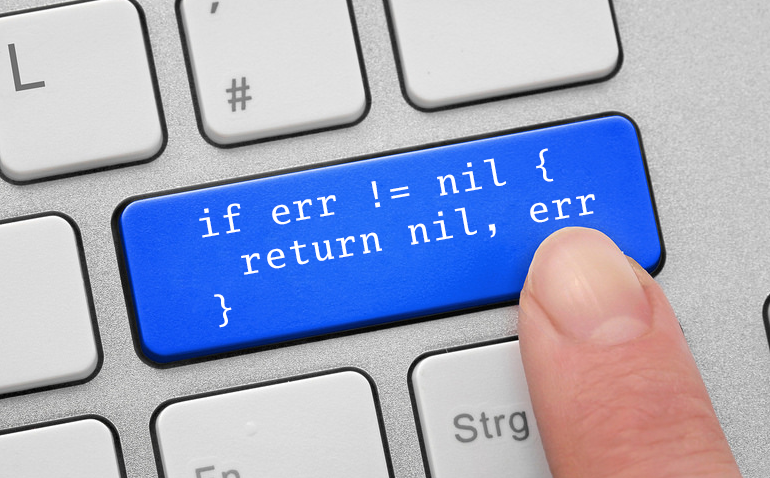
Error Handling in Go -- "Rob Pike Reinvented Monads", Jun 2016.
- amos - I want off Mr. Golang's Wild Ride; Feb 2020. Mostly around problems on Windows.
Project structure
- How to start a Go project in 2023 | Ben E. C. Boyter; May 2023.
- The Within Go Repo Layout - Christine Dodrill; Sep 2020.
- Simple Go project layout with modules - Eli Bendersky's website; Oct 2019
A very common question Go beginners have is "how do I organize my code?". Some of the things folks are wondering about are:
- How does my repository structure reflect the way users import my code?
- How do I distribute commands (command-line programs that users can install) in addition to code?
- How do modules change the way I organize my code?
- How do multiple packages coexist in a single module?
Moving to Go
History
Learning
The Go Programming Language by Donovan and Kernighan.
- Learn Go with Tests - Learn Go with tests this is an innovative approach to learning Go. Via tests.
- Go Books
- The Complete Guide to Learning Go - Calhoun.io
- Advise from Go developers to Go programming newbies
- 50 Shades of Go: Traps, Gotchas, and Common Mistakes for New Golang Devs
- Go by example
- working-with-go
- Network programmign with Go last update Apr 2012.
- Go In 5 Minutes - Short, helpful screencasts for professional Go developers
- quii/learn-go-with-tests: Learn Go with test-driven development
Training
Reading
- Static analysis features of Godoc
- Language Design in the Service of Software Engineering
- The case for Go language -- collection of opinion article on Go.
- and some more ...
- Ten Useful Techniques in Go
Development practices
The Go team has published official guidelines for organizing / structuring a Go project: https://go.dev/doc/modules/layout This includes recommended project layouts for different kinds of projects: a simple package, a command-line tool, a mix of the two, etc. via
Deployment practices
- Deploying Go servers with Docker
- The Go binary diet -- reducing go binary size.
Performance monitoring
User Groups
- Go Steel Programmers - Pittsburg, PA.
Presentations
Libraries
- Go-git discussion about this git client library [esp see gogit].
- webgo.io -- inspired by web.py
- Go-LINQ -- LINQ for Go.
- Godep -- Go package dependency management.
- Gox -- Go cross compile tool.
- overseer -- Monitorable, gracefully restarting, self-upgrading binaries in Go
- GitHub - xlab/c-for-go: Automatic C-Go Bindings Generator for Go Programming Language
Read Code
- reticulum -- distributed image and thumbnail server.
- Go by example and it's source code
- augend -- fact database using Riak and Go.
- l3x.github.io golang-code-examples
List of Lists on Go
- Awesome Go -- A curated list of awesome Go frameworks, libraries and software.
Editors
- emacs for go 2014/8/28
- Microsoft/vscode-go: An extension for VS Code which provides support for the Go language. -- worked out pretty well for me on Mac OSX. I was able to configure all the features including debugging using the "delve" debugger. Has nice snippets feature that can be turned on .
- GitHub - piqoni/vogte: The Agentic TUI for Go codebases
Vogte uses a two-step approach for providing tasks to the LLM. In the first step, it extracts relevant parts (structs/interfaces/methods along with signatures) from your repository and asks the LLM which files it needs in full to solve the problem expressed by the user. During this step, the LLM returns a list of files, which vogte then provides back with their full content so the LLM can apply the solution.
FFI
Garbage Collection
Why Discord is switching from Go to Rust - Discord Blog
In Go, on cache key eviction, memory is not immediately freed. Instead, the garbage collector runs every so often to find any memory that has no references and then frees it. In other words, instead of freeing immediately after the memory is out of use, memory hangs out for a bit until the garbage collector can determine if it’s truly out of use. During garbage collection, Go has to do a lot of work to determine what memory is free, which can slow the program down. These latency spikes definitely smelled like garbage collection performance impact, but we had written the Go code very efficiently and had very few allocations. We were not creating a lot of garbage. After digging through the Go source code, we learned that Go will force a garbage collection run every 2 minutes at minimum. In other words, if garbage collection has not run for 2 minutes, regardless of heap growth, go will still force a garbage collection.
garbage collection - How fast is the go 1.5 gc with terabytes of RAM? - Stack Overflow
3-4ms pauses under 1.6, with about an 8GB heap and 150M allocations/minute.
- Garbage Collection In Go : Part I - Semantics
- Garbage Collection In Go : Part II - GC Traces
- Garbage Collection In Go : Part III - GC Pacing
Concurrency
- Interesting ways of using Go channels | Nomad Software
- Visualizing Concurrency in Go · divan's blog
- Fun with Concurrency in Golang · Alex Sears
Programming notes
Debugging notes
Build notes
Cross compiling a binary for Linux on Mac.
git clone git@github.com:xyproto/algernon.git
cd algernon
env GOOS=linux GOARCH=amd64 go build
Tools
Package management
Web
- So you want to expose Go on the Internet
- REST Servers in Go: Part 1 - standard library - Eli Bendersky's website
- valyala/quicktemplate: Fast, powerful, yet easy to use template engine for Go. Optimized for speed, zero memory allocations in hot paths. Up to 20x faster than html/template
Frameworks
Go Blueprint Hello -- "Choose your desired features, and we'll generate the command you can use to create your project."
blackfyre/wga: Jumping forward ~30 years --
This repositry contains the code for the Web Gallery of Art project. The project is a web application that allows users to browse through a collection of paintings, sculptures and other forms of Art. This project is inteded to shave off the 3 decades of tech debt on the original website and provide a modern, responsive and user friendly experience with the same content.
-- study this project and the choices it has made -- pocketbase, htmx, bulma, golang, sass, andgoreleaseranthdm/superkit still in development.
Templating
templ -- "A HTML templating language for Go that has great developer tooling." github
package main

templ Hello(name string) {
<div>Hello, { name }</div>
}

templ Greeting(person Person) {
<div class="greeting">
@Hello(person.Name)
</div>
}
The Simpsons in CSS
pattle.github.io
add validation of printf format and arguments by WalterBright · Pull Request #10812 · dlang/dmd · GitHub
github.com
#dlang D now validates printf format arguments which uncovered an unexpectedly large number…
#dlang D now validates printf format arguments which uncovered an unexpectedly large number…
Software tools
List of programs and shell scripts that I find useful.
- 2014-11-26: Conkeror
- 2015-05-06: ccat -- colourised cat. there are other ways to do it, including using pygmentize
- 2016-07-22: joeyespo/grip: Preview GitHub Markdown files like Readme locally before committing them.
- 2018-02-19: java_launcher: Helper script to treat Java programs as scripts.
- 2019-12-05: imgproxy -- imgproxy does one thing — resizing remote images — and does it well. It works great when you need to resize multiple images on the fly to make them match your application design without preparing a ton of cached resized images or re-doing it every time the design changes. imgproxy is a Go application, ready to be installed and used in any Unix environment
- 2020-02-25: antonmedv/fx: Command-line tool and terminal JSON viewer 🔥
- 2020-02-25: antonmedv/red: Terminal log analysis tools
Meta (lists made by other people)
- cjbarber/ToolsOfTheTrade: Tools of The Trade, from Hacker News.
- An Illustrated Guide to Useful Command Line Tools - WezM.net by Wesley Moore
Chrome extensions
- PriceBlink --useful for comparison shopping. I've saved quite a bit of money using this extension.
- Personal Blocklist -- filter out content farms from your searches. -Adblock Plus -- A must have for all. -Send this link with Gmail -- very useful to share the web links via email. Works even Google Apps domains. -MeasureIt! -JSONView -- "an extension that helps you to parse and view JSON documents". Highly recommended if you do web development -Screen Capture -- screen capture, highlighting and annotation.
Safari extensions
- Ghostery -- block intrusive javascript.
Pandoc
pandoc is a fantastic program to convert text to various output formats.
Typcial usage: To convert a markdown formatted text file to html
$ pandoc somefile.txt -f markdown -t html --standalone -o somefile.html
See the detailed pandoc page.
Command line tools
abcde
Command line tool to rip CDs to .mp3.
Installation: $ sudo apt-get install abcde id3v2
Insert Disc #1 of a 3-cd audio book $ abcde -o mp3 -p -W 1.
bcat
bcat pipe to browser utility.
Typical usage: To see the git log.
$ git log -p --color | bcat
fd
sharkdp/fd: A simple, fast and user-friendly alternative to find.
gist
gist pastes code, text to [gist.github.com] from command line.
$ gist one.txt
partimage
partimage is a Linux disk imaging software. It has a curses based interface to guide you through the options.
Typical usage: make a backup of an entire HDD(say SSD/Flash of a prototype) to your desktop.
Make Image:
$ partimage -z1 save /dev/sdg1 $HOME/backup/prototype-hdd-20100707.partimg.gz
Restore:
$ partimage restore /dev/sdg1 $HOME/backup/prototype-hdd-20100707.partimg.gz
qpdf
qpdf -- is a command-line program that does structural, content-preserving transformations on PDF files.
http-prompt
pip install http-prompt
fzf
junegunn/fzf: A command-line fuzzy finder written in Go
peco
q
entr
entr(1) -- Run arbitrary commands when files change
ripgrep
ripgrep recursively searches directories for a regex pattern. See rga, like rg, but also search in PDFs, E-Books, Office documents, zip, tar.gz, etc.
sd
sd is an intuitive find & replace CLI.
rargs
rargs xargs + awk with pattern matching support. ls *.bak | rargs -p '(.*)\.bak' mv {0} {1}
rak
lizmat/App-Rak: 21st century grep / find / ack / ag / rg on steroids
Code tools
Database tools
- dbeaver -- crossplatform database manager for all popular sql dbs and some nosql dbs.
Web development tools
Yaak is a cross-platform desktop app for interacting with REST, GraphQL, and gRPC
Data Cleaning
- jq - command line json processor
- HTML-XML-utils -- makes scraping tasks that much easier.
- pup - Parsing HTML at the command line. written in go.
- xidel - HTML/XML data extraction tool which is written in Pascal; also by the same author - texstudio
Interesting ~/bins on github
Some more linked on this page: 15 Greatest Open Source Terminal Applications Of 2012
Interesting
- ronn - the opposite of roff.
Lorem ipsum
OCR
- Screenotate Take screenshots you can search.
ASCII Banner
Use Figlet and Toilet to generate ascii text banners in linux terminal.
OCaml programming language
OCaml for the impatient . The web's quickest and dirtiest OCaml getting started guide
This is the most up to date setup using Opam, jbuilder, Merlin, VSCode etc.,(. August 2017). (ed note, 2023-10-10: Since then the OCaml system has made huge strides in developer productivity.)
xvw.lol - Why I chose OCaml as my primary language, an opinion piece by a programmer that uses OCaml professionally at tarides. Is a good intro the ecosystem in 2025; via
Language
Concurrency
Learning OCaml
Courseware
- Cornell's 3110 -- Data Structures and Functional Programming course (2013); 2016 2018; 2020
- Cornell's Functional programming in OCaml, CSCI 49201.
- Harvard's CS51 -- Introduction to Computer Science II: Abstraction and Design
- Functional Programming -- Cornell, 2016 by Michael Clarkson
- Computer Laboratory – Course pages 2016–17: Types
- Computer Laboratory – Course pages 2016–17: Advanced Functional Programming
- CS 3110 Tournament History (CS.Cornell)
- 2017 fall
- Functional Programming in OCaml -- Fall 2018 Edition Cornell's cs3110, compiled into a gitbook.
- Functional Data Structures by PLRagde at Waterloo
- Functional Programming in OCaml - Spring 2019 Edition
- Introductory Data Structures and Algorithms — YSC2229 2021 This course on classic imperative data structures and algorithms has been offered by Ilya Sergey at Yale-NUS College in 2019-2021.
Tutorials
- Introduction to OCaml
- OCaml for the skeptical
- Using, Understanding, and Unraveling The OCaml Language by Didier Remy [2002].
- An overview of OCaml [2015].
- OCaml and Emily In a Walnut -- Custom Designed For C++ and Java Programmers
- Early OCaml workflow pains
- ocamllabs/ocaml-effects-tutorial: Concurrent Programming with Effect Handlers (CUFP'17)
- A Tutorial to OCaml -ppx Language Extensions | Victor Alexandru Darvariu
- dmbaturin's blog - ocaml and specifically - introduction to OCaml
- Getting Started with OCaml in 2021 · Perpetually Curious Blog
Best practices
Books
- Developing applications with OCaml -- online book by INRIA.
- Unix System Programming in OCaml
- How to Think like Computer Scientist (OCaml)
- Fun of Programming -- a work in progress.
- Real World OCaml -- expected in Fall 2012(!)
Textbooks
- uds-psl/Prog -- Introduction to Functional Programming and the Structure of Programming Languages using OCaml by Gert Smolka
- OCaml Programming: Correct + Efficient + Beautiful — OCaml Programming: Correct + Efficient + Beautiful
Articles
- How OCaml Type Checker works. In general Olegs http://okmij.org/ftp/ is a treasure trove of CS material.
- Memory Layout in Ocaml -- comment by
avsm - Why OCaml in 2024 by
kcsrk - Why OCaml [2002]. Also has many links to OCaml pages. - OCaml programming with emacs.
- Another Why OCaml
- OCaml briefly -- a brief tour of OCaml.
- What is the appeal of OCaml today? Why use it over something like Haskell or Java (reddit); 2018-07-11.
Blogs
- Danny Willems - Blog - You have ideas, I have skills.
- let author = “Rudi Grinberg” — Rudi Grinberg documentation
- Shayne Fletcher
- dmbaturin's blog - ocaml tagged articles -- has a series on "Introduction to OCaml". Also notable - If you think ReasonML compiles to JS, you are wrong
- Jane Street Tech Blog
Resources
- Learn OCaml v.0.14.1 -- François Pottier designed a series of advanced interactive OCaml exercises where students implement: - The nondeterminism monad - Parser combinators - An algebraic pretty-printer & this is an in-browser IDE!
- TryOCaml - This site is a demo for the programming environment used during the first session of the OCaml MOOC.
- Ocaml Reddit
- OCaml for the Skeptical: OCaml in a Nutshell
Papers
- Polymorphism, subtyping and type inference in MLsub; online editor of the inference enginer
- PhD Thesis: Tierless Web programming in ML | Drup's thingies
Package managers
- opam
- GODI
- YYPkg
- Using jbuilder/topkg -- "Platforms, Packaging, Progress"; [Aug 2017]
- ~lthms: Building Static Binaries for OCaml Projects; Dec 2023.
OCaml Languages
Reason: a syntax for OCaml, so native development or melange development to compile to JS
ReScript: a syntax similar to Reason, but the entire toolchain. Closer to JavaScript, can't compile to native.
Talks
Yaron Minsky:
- OCaml for the masses in ACMQueue.
- Effective ML talk at Harvard and "Caml Trading" talk at CMU.
- More Effective ML
Miscellaneous
- OCaml Skeleton a jumpstart environment for to get code up-and-running. An example application with unit tests is a nice sandbox for language discovery.
- Try Ocaml a web based OCaml REPL.
- OCaml style guide
- another OCaml style guide from UPenn, which is based on,
- SML style guide
OCaml as a replacement language
- Replacing Python with OCaml. Thread and thread2
- Felix is offered an alternate to OCaml
- OCaml vs Haskell discussion on Quora. YMMV.
- 8 months of OCaml after 8 years of Haskell in production - DEV Community -- has a table comparing OCaml and haskell
- OCamlers' critique of Haskell
Writing languages using OCaml
- Developing Applications with Ocaml - Chapter 6 implements a BASIC interpreter.
- The programming language zoo by Andrej Bauer has multiple examples of simple languages built using OCaml.
- Toy APL implementation by Kragen Sitaker.
- CS 421/521: Compilers and Interpreters
- Lua-ML pure OCaml implementation of Lua 2.5 by Normal Ramsey.
- ML to C++ compiler
Tools, ecosystem and libraries
- Setting Up an OCaml Development Environment in Debian - The Always Learning Marty ; Aug 2018
- OCaml Lint detects common errors in OCaml code.
- IOCaml, OCaml kernel for iPython.
- Domical = OCaml + Iodide - Iodide; Sep 2018.
- Regular expressions in OCaml
- Opam-Android --An OCaml 4.02 toolchain for Android and several useful libraries
- OCaml Scientific Computing — Owl Numerical Library
Js_of_Ocaml
- js-skeleton -- sample
project showing how to build a Javascript web-app using
js_of_ocaml,TyXMLandReact - H.261 Video Decoding in OCaml. -- This notebook will demonstrate a simple H.261 Video Decoder written in OCaml and compiled to javascript with js_of_ocaml.
OCaml project tools
Build tools:
- OMake
- OCamlbuild
- OASIS
- opam-publish -- A tool to ease contributions to opam repositories
Some opinions on the merits of using these tools:
What is the preferred way to structure and build OCaml projects?
- recco: use
ocamlbuildbutoasismay be better now. ocamlbuildcomes with the distribution.oasisbuildsmyocamlbuild.mlfile automatically for you.oasisgives you access tooasis-db, a CPAN like system.- to manage libraries, use
ocamlfind. opamreally doesn't care about build systems.- MLState is using
ocamlbuildfor buildingOpa lang.
- recco: use
Code bits
Explicit Typing of a polymorphic variant
type download_result =
  [ `aborted_by_user
  | `network_failure of string
  | `success of filepath ]
Information
- What is good about OCaml's module system?
- What good is First class Modules?
- "Using an error monad in a language like ocaml is superior to exceptions in almost every way." via
Sample code / Read Source
- github.com/chrismamo1/zipper -- a CLI tool in the imperative style.
- collaborative text editor using Eliom
- vbmithr (Vincent Bernardoff) / Repositories
- bcpierce00/unison: Unison file synchronizer
- Gopiandcode/ocamlot: An Activitypub server in OCaml!
Multicore OCaml
- Multicore OCaml - What's coming in 2021 - Speaker Deck; Anil and KCSRK
- Practical OCaml, Multicore Edition by Yawar Amin
Object oriened OCaml
- The O in OCaml -- a reddit discussion, with strong answers from 'gasche'.
- Experiences with OCaml objects - Thomas Leonard's blog
Hindley-Milner type system
- Show HN: Hindley-Milner Type Inference Algorithm in OCaml | Hacker News see links within.
Semantics
Web programming with OCaml
PPX
Comparison
- OCaml vs haskell vs go
- Thread by @wilfredh: I'm a lisper who has spend a little over six months getting up to speed in OCaml, and it's been really interesting...
min-caml
esumii/min-caml: a complete optimizing native-code compiler for a reasonably usable subset of OCaml, in 2000 lines of OCaml. Paper.
Running log
PSA: Tired of inscrutable type errors from OCaml? If you use jbuilder/dune, just add this to your jbuild build stanza:
(flags (:standard -short-paths))and your type errors and inferred types from Merlin will magically improve!
NixOS
- Nix-powered development with OCaml - Dimitrije's Website; 2023/3/6
- Bye Opam, Hello Nix | Emil Privér; May 2024.
Data Science and AI
- OCaml Scientific Computing: Functional Programming in Data Science and Artificial Intelligence (Undergraduate Topics in Computer Science): Wang, Liang, Zhao, Jianxin, Mortier, Richard: 9783030976446: Amazon.com: Books (Book); Springer link
OCaml Garbage Collection
- Garbage Collection · OCaml Tutorials
- An in-depth Look at OCaml’s new “Best-fit” Garbage Collector Strategy | OCamlPro
- Lecture 26 of Cornell CS3110
My notes
emacs + utop + merlin + typerex = Excellent IDE.
2014-11-25: Run ocamlbrowser in a shell to see a tk based documentaiton browser.
OCamlEditor
Fortunately, you can install it using opam install ocamleditor... unfortunately you are dealing with various idiosyncrasies of GTK on mac... ugh.. To keep it short, lablgtk
installation by opam might fail with pkg-config errors. The fix is:
https://github.com/Homebrew/homebrew/issues/14123#issuecomment-37896791
... before running opam install ocamleditor. Solution
via
Note: looks butt-ugly on mac, as expected.
opam allows you create "sandboxes" and install packages in them. See the -A --alias-of option.
See Setting up an OCaml environment for Programming. Use ocamlfind, ocamlbuild and make.
Apr 2016. See ogen -- a tool for creating new OCaml projects with OPAM, Oasis, and Merlin.
Compiling an ocaml file:
That has no dependecies
ocamlopt foo.ml -o foo
that has a dependency (say csv)
ocamlfind ocamlopt -o test -linkpkg -package csv test.ml
ocamlfind
ocamlfindis a program that finds all the ocaml packages that are installed on your system (or opam instance, for that matter).ocamlfind -hto see list of commands available.ocamlfind printconfshows the path configs etc.,ocamlfind listwill list all the packages installed.
ocamldep
typical usage: ocamldep *.ml, which will dumps dependency lines.
** Different file types **
.cmo--.cmi--.mli--
--
OCaml has good study materials -- textbooks, lecture notes. There is also the advantage of being able to roll-over to F# for "enterprise" stuff.
The Sacred Roger Scruton | The American Conservative
the%20sacred%20roger%20scruton%20%7c%20the%20american%20conservative
Untitled (https://www.youtube.com/watch?v=6Pkq_eBHXJ4&feature=youtu.be&t=40)
youtube.com
@clynbech @deech you are wrong ;)
@clynbech @deech you are wrong ;)
Chattersome Labs
chattersomelabs.blogspot.com
@JamesMarsh79 @deejmon Doyle has reported some of his twitter work here -
@JamesMarsh79 @deejmon Doyle has reported some of his twitter work here -
Interesting Programming Languages
An opinionated collection of programming languages. This is a list of what I consider interesting. Requests to add to this list are welcome, but there is no guarantee I'll include them. As you can see many mainstream programming languages are missing from this list.
Of these, I try to maintain interest in -- ATS, Chapel, Zig, Nim, Flix, Crystal, Vale, and Roc, outside the mainstream languages.
- Alore is a language that explores optional typing in a Python-like programming language.
- Alpaca is a statically typed, strict/eagerly evaluated, functional programming language for the Erlang virtual machine (BEAM). At present it relies on type inference but does provide a way to add type specifications to top-level function and value bindings. It was formerly known as ML-flavoured Erlang (MLFE).
- Amber -- "The Programming Language compiled to bash. Write your scripts in a modern type-safe and runtime-safe programming language that handles many bugs and mistakes during compilation process."
- appcypher/astro: A multi-paradigm programming language that compiles to WebAssembly and native code. with Python syntax.
- Arturo programming language; looks like REBOL? and claims "Want to ship your scripts anywhere? For any operating system? Without weird dependencies and without asking the user to install an endless list of modules/gems/packages? That's exactly what Arturo was designed for.", and batteries included.
- Asymptote is a descriptive vector graphics language that provides a natural coordinate-based framework for technical drawing. Labels and equations are typeset with LaTeX, for high-quality PostScript output.
- ATS is a statically typed programming language that unifies implementation with formal specification. It is equipped with a highly expressive type system rooted in the framework Applied Type System, which gives the language its name. In particular, both dependent types and linear types are available in ATS.
- Ballerina "Ballerina is a compiled, transactional, statically and strongly typed programming language with textual and graphical syntaxes. Ballerina incorporates fundamental concepts of distributed system integration into the language and offers a type safe, concurrent environment to implement microservices with distributed transactions, reliable messaging, stream processing, and workflows." See ballerina.
- Boomerang is a language for writing lenses—well-behaved bidirectional transformations—that operate on ad-hoc, textual data formats. Every lens program, when read from left to right, describes a function that maps an input to an output; when read from right to left, the very same program describes a "backwards" function that maps a modified output, together with the original input, back to a modified input.
- Biscuit is simple imperative programming language using LLVM backend implemented in C. See Tine editor
- Blorp; Blorp is meant to feel direct at the surface while keeping the compiler's safety and runtime choices explicit.. Static Types, Hindley-Milner-Style inference, Value Semantics, Perceus Ownership, Native Output. Blorp compiles to C, so idiomatic Blorp code is intended to run within range of hand-written C.
- C2 an evolution of C, using LLVM.
- C3 - Full C ABI compatibility, Module system, Generic modules, Design by contract, Zero overhead errors, Semantic macro system, First-class SIMD vector types, Struct subtyping, Safe array access using slices, Easy to use inline assembly, Cross-platform standard library which includes dynamic containers and strings, LLVM backend
- Cell offers, among other things, a very flexible, entirely structural type system; deterministic, repeatable execution; support for reactive programming; the ability to use relations to store data; transactions and propagation of undefined values for error handling; and ortogonal persistence. "Cell is designed to complement and integrate with your primary language, not to replace it. Once a component of an application has been implement in Cell, the compiler will generate from it an easy-to-use Java, C++ or C# class that can be integrated into an existing project. Support for other languages will be added in the future."
- Chapel is a modern programming language that is parallel, productive, portable, scalable and open-source by Cray.
- Ciao is a modern prolog implementation and a general-purpose programming language which supports logic, constraint, functional, higher-order, and object-oriented programming styles. Its main design objectives are high expressive power, extensibility, safety, reliability, and efficient execution.
- Circle compiler enables you to metaprogram C++ in C++. It encourages a seamless mixing of compile-time and runtime capabilities that upends decades of language design.
- Cito automatically translates the Ć programming language to C, Java, C#, JavaScript, ActionScript, Perl and D. Ć is a new language, aimed at crafting portable programming libraries, with syntax akin to C#.
- Clean is a general purpose, state-of-the-art, pure and lazy functional programming language designed for making real-world applications. Some of its most notable language features are uniqueness typing, dynamic typing, and generic functions. quick look.
- Cool is a small language designed for use in an undergraduate compiler course project. While small enough for a one term project, Cool still has many of the features of modern programming languages, including objects, automatic memory management, and strong static typing. Used for Stanford CS1 Compiler class.
- Crystal -- is a ruby syntax inspired, statically type checked language that compiles to binary. Mint is a language for writing Single page applications. Mint is written in Crystal.
- Cuneiform is a functional programming language for large-scale data analysis workflows. Cuneiform uses distributed Erlang to scalably run in cluster and cloud environments. The flexible foreign function interface lets you integrate tools and libraries from many different sources. This allows you to drive a heterogeneous software collection through a uniform interface (Bash, Erlang, Python, Java, R, MATLAB, JS). Static type checking.
- Curry -- Haskell with Logic Extensions
- Cyber -- is a scripting language for fast, efficient, and concurrent scripting, written in Zig -- Dynamic and static types. Concurrency with fibers. Memory safe. FFI and Embeddable.Fast VM and JIT. Cross platform.
- Dafny: A Language and Program Verifier for Functional Correctness - Microsoft Research
- Dao is a lightweight and optionally typed programming language; Optional typing with type inference and static type checking; Object-Oriented Programming (OOP) with class and mixin class; Abstract interface and concrete interface to supplement class-based for OOP; Code section methods as a better alternative to functional methods; Support closures, anonymous functions; Deferred block and exception handling by defer-recover; Native support for concurrent programming; Concurrent garbage collection;
- Derw -- is a programming language aimed at making complex apps in a simple way. It's built on top of TypeScript and Node, so it's easy to have interop with TypeScript. See also Gren
- dg — it's a Python! No, it's a Haskell! -- "Slow. Stupid. Absolutely adorable.". Python with Haskell syntax.
- Duet delta is an educational dialect of Haskell aimed at interactivity.
- Eff Programming Language is a functional programming language based on algebraic effect handlers. This means that Eff provides handlers of not only exceptions, but of any computational effect, allowing you to redirect output, wrap state modifications in transactions, schedule asynchronous threads, and much much more… Try it out in the browser
- The Egison Programming Language
- Ela combines strict and lazy evaluation, dynamic typing and features, which are normally adopted by statically typed languages, such as algebraic data types andHaskell style type classes. Compiles to .NET
- Euphoria -- the language that brought me back from the C++ induced panic :D
- rxi/fe -- A tiny, embeddable language implemented in ANSI C. Used to make grid based game framework cel7
- DRAKON, is a visual language for specifications. Discussions
- Eyg
- Elixir is a functional meta-programming aware language built on top of the Erlang VM.
- Fay is a proper subset of Haskell that compiles to JavaScript
- Fennel -- Lisp in Lua. "Full Lua compatibilty, Zero Overhead, Compile-time macros, Embeddable".
- Felix claims to have its own type system based on a combination of Ocaml and Haskell. Like Ocaml it provides strong support for functional programming, whilst also supporting imperative programming. The type system is strict.
- Flapjax is a new programming language designed around the demands of modern, client-based Web applications. Its principal features include: Event-driven, reactive evaluation; An event-stream abstraction for communicating with web services; and Interfaces to external web services. Flapjax is just a JavaScript framework. Flapjax is built entirely atop JavaScript, it runs on traditional Web browsers without the need for plug-ins or other downloads. It integrates seamlessly with existing JavaScript code and other frameworks.
- Flask staged Functional Programming for Sensor Networks
- Flex group at YC Research has a few interesting lanauges like: Ohm, Seymour, Purple, Trainee, and transcript.
- Flix -- "takes inspiration from F#, Go, OCaml, Haskell, Rust, and Scala. Flix visually resembles Scala, but its type system is closer to that of OCaml and Haskell. Its concurrency model is inspired by Go-style processes and channels. Flix compiles to JVM bytecode and runs on the Java Virtual Machine. Flix supports full tail call elimination which means that tail calls (even to other functions) never overflow the stack."
- Futhark - A High Performance Functional Array Language. "a small programming language designed to be compiled to efficient parallel code. It is a statically typed, data-parallel, and purely functional array language in the ML family, and comes with a heavily optimising ahead-of-time compiler that presently generates GPU code via OpenCL, although the language itself is hardware-agnostic."
- Gleam is a statically typed functional programming language for building scalable concurrent systems. It compiles to Erlang and has straightforward interop with other BEAM languages such as Erlang, Elixir and LFE. Interview with the creator of Gleam
- Gren is a functional programming language with carefully managed side-effects and a strong static type system. is a "fork" of Elm with a node.js target.
- Gush: A stack based language eventually for genetic programming
- Hazel, a live functional programming environment featuring typed holes.
- hobbes -- a programming language, JIT compiler, and database system for low-latency, high-volume trading applications (built at Morgan Stanley).
- Idris is is a general purpose pure functional programming language with dependent types.
- Imba is a programming language for the web that compiles to performant and readable JavaScript. It has language level support for defining, extending, subclassing, instantiating and rendering dom nodes.
- Inko " is a gradually-typed, safe, object-oriented programming language for writing concurrent programs. By using lightweight isolated processes, data race conditions can not occur. The syntax is easy to learn and remember, and thanks to its error handling model you will never have to worry about unexpected runtime errors."
"Inko is an object-oriented programming language, drawing heavy inspiration from Smalltalk, Self, and Ruby. There are no statements used for conditionals and loops, instead Inko uses message passing for (almost) everything." Processes don't share their memory, and communicate by passing messages, which are deep copied. This removes the need for explicit synchronisation, and makes data race conditions impossible. Inko uses a high performance parallel garbage collector, based on Immix. Each process is garbage collected independently, removing the need for a global stop-the-world phase. Inko is an interpreted programming language, with a bytecode virtual machine written in Rust. Inko is gradually typed, with static typing being the default. This gives you the safety of a statically typed language, and the option to exchange this for the flexibility of a dynamically typed language. Related reading: * Joe Duffy - The Error Model
- ISPC -- Intel® SPMD Program Compiler is a compiler for a variant of the C programming language, with extensions for "single program, multiple data" (SPMD) programming. Under the SPMD model, the programmer writes a program that generally appears to be a regular serial program, though the execution model is actually that a number of program instances execute in parallel on the hardware. The story of ispc: origins (part 1)
- Janet is a functional and imperative programming language. Janet makes a good system scripting language, or a language to embed in other programs. Think Lua or Guile. Janet also can be used for rapid prototying, dynamic systems, and other domains where lisp shines.
- Jolie is a service oriented proramming language that compiles to the JVM. I'm reminded of Ballerina. Jolie crystallises the programming concepts of service-oriented computing as linguistic constructs. The basic building blocks of software are not objects or functions, but rather services that can be relocated and replicated as needed. A composition of services is a service.
- Julia is a high-level, high-performance dynamic programming language for technical computing.
- Kit is a “Compiles-to-C” language. It is strong, and statically typed with many modern language features like type inference, algebraic data types, pattern matching, generics, implicits, while still having low level features like raw pointers, and manual memory management. Kit is written in Haskell. kit notes.
- Koka -- is a function-oriented programming language that seperates pure values from side-effecting computations, where the effect of every function is automatically inferred. The language is strict (as in ML), but seperates pure values from side effecting computations (as in Haskell). Through the effect types, there is also a strong connection to its denotational semantics, where the effect type of each function has a direct translation to the type signature of the denotational function. more Recently, Koka fully supports user-defined effects through algebraic effect handlers.
- Koto -- language for adding scripting to applications developed in Rust. Koto's runtime is fast enough for many applications, with performance comparable to similar embedded scripting languages for Rust like Rhai and Dyon
- lambdaway :: _ -- S-expression based markup, styling & scripting
- The Lemon Programming Language -- python with curly braces. embeddable.
- Lily -- an interpreted, statically typed programming language focusing on expressiveness and safety.
- The Little Language is a statically typed, C-like scripting language. "... might be useful for you if you are still using Tcl (or Tcl/Tk) but wish it had a more C-like syntax. ". L forum on bitkeeper
- Lobster is a game programming language. Unlike other game making systems that focus on an engine/editor that happens to be able to call out to a scripting language, Lobster is a general purpose stand-alone programming language that comes with a built-in library suitable for making games and other graphical things. Looks like python, but is statically typed.
- Logtalk is an object-oriented logic programming language that can use most Prolog implementations as a back-end compiler.
- Luna "is a data processing and visualization environment built on a principle that people need an immediate connection to what they are building. It provides an ever-growing library of highly tailored, domain specific components and an extensible framework for building new ones. Luna targets domains where data processing is the primary focus, such as data science, IoT, bioinformatics, graphic design and architecture."
- LuxLang/lux: The Lux Programming Language "It's meant to be a functional, statically-typed Lisp that will run on several platforms, such as the Java Virtual Machine and JavaScript interpreters." Written in Clojure. tutorial.
- Mercury is a logic/functional programming language, which combines the clarity and expressiveness of declarative programming with advanced static analysis and error detection features.
- Myrddin is a programming language that runs close to the metal, giving the programmer predictable and transparent behavior and mental model. It also does strong type checking, generics, type inference, closures, and traits.
- Mythryl is a rewrite of the SML/NJ compiler
- Nim -- see my more exhaustive set of notes here.
- Nitlanguage.org
- Objective-Smalltalk is an evolution of Smalltalk based on the Objective-C runtime.
- odinlang - Odin is a general-purpose programming language with distinct typing built for high performance, modern systems and data-oriented programming. Odin is the C alternative for the Joy of Programming. ed: seems to have gained much popularity among game developers.
- Onyx -- A data-oriented, expressive, and modern programming language, targeted at WASM.
- Opis reliable distributed systems in Ocaml (paper, 2009).
- P: Safe Asynchronous Event-Driven Programming by Microsoft Research
- P P provides a high-level state machine based programming language to formally model and specify distributed systems. See Youtube talk
- Picat is a simple, and yet powerful, logic-based multi-paradigm programming language aimed for general-purpose applications. Picat is a rule-based language, in which predicates, functions, and actors are defined with pattern-matching rules. Picat incorporates many declarative language features for better productivity of software development, including explicit non-determinism, explicit unification, functions, list comprehensions, constraints, and tabling. Picat also provides imperative language constructs, such as assignments and loops, for programming everyday things. The Picat implementation, which is based on a well-designed virtual machine and incorporates a memory manager that garbage-collects and expands the stacks and data areas when needed, is efficient and scalable. Picat can be used for not only symbolic computations, which is a traditional application domain of declarative languages, but also for scripting and modeling tasks.
- Pike - a dynamic programming language with a syntax similar to Java and C. "the World Wide Web servers Roxen WebServer and Caudium are both written in Pike. Pike’s advanced data types and built-in support for sockets makes it ideal for use in Internet applications."
- Piplin is a language that lets you write Clojure to simulate and program FPGAs.
- Ponylang -- is an object-oriented, actor-model, capabilities-secure, high-performance programming language.
- Play -- a statically typed stack language (aka Forth)
- Propane Language a language for simple, correct-by-construction network configuration
- Pure -- is a modern-style functional programming language based on term rewriting. It offers equational definitions with pattern matching, full symbolic rewriting capabilities, dynamic typing, eager and lazy evaluation, lexical closures, built-in list and matrix support and an easy-to-use C interface. The interpreter uses LLVM as a backend to JIT-compile Pure programs to fast native code.
- Pyret -- python like language (syntactially) with FP ideas. inbuilt testing emphasis with
where:keyword. structured data like OCaml etc., Runs on top of Racket. - The QED programming language -- "[for]... designing complex graphical user interfaces the simple way. Its parallel GUI/business logic (GUI/BL - or guible) coding paradigm offers unequaled binding power, which considerably reduces the lines of code required to develop a GUI application. QED runs in both native and web environments, without changing a single line of code."
- RacketScript is an experimental lightweight Racket to JavaScript (ECMAScript 6) compiler. RacketScript aims to leverage both JavaScript and Racket's ecosystem, and make interoperability between them clean and smooth. RacketScript takes in Racket source files, uses Racket's macro expander to produce Fully Expanded Programs, and then compile these fully expanded programs to JavaScript.
- Rascal -- is a metaprogramming language that integrates source code analysis, transformation, and generation primitives on the language level
- Red ; FAQ
- Reva -- a small, cross-platform Forth. Recommended by @deech in the context of "read the source code of the programming language to learn how things work".
- Roc's goal is to be a fast, friendly, functional language. tutorial; via
- Rosie Pattern Language -- a better Regex. See MWPLS 2019 slides (PDF). Has a REPL, JSON output, Can use with C, Python, Haskell, Go.
- Roy is a programming language that tries to meld JavaScript semantics with some features common in static functional languages and targets JavaScript.
- Rye is a high level, homoiconic dynamic programming language based on ideas from Rebol, flavored by factor, Linux shell and golang. For Interactive use, backend, servers, information exploration and processing. It's written in Go and could also be seen as Go's scripting companion as Go's libraries are very easy to integrate, and Rye can be embedded into Go programs as a scripting or a config language.
- Quirrel is a purely declarative query language designed for performing analytics and statistics on large-scale, multi-structured data sets.
- Quorum -- an OOPs lang for teaching that compiles to Java byte-code.
- scrapscript solves the software sharability problem. Modern software breaks at boundaries. APIs diverge, packages crumble, configs ossify, serialization corrupts, git tangles, dependencies break, documentation dies, vulnerabilities surface, etc. To make software safe and sharable, scrapscript combines existing wisdom in new ways:
- all expressions are content-addressible “scraps”
- all programs are data
- all programs are “platformed”
- Self is a prototype-based dynamic object-oriented programming language, environment, and virtual machine centered around the principles of simplicity, uniformity, concreteness, and liveness.
- SharpScript, a scripting language for .NET Core and .NET Apps that utilizes a familiar expressive Syntax to enable dynamic scripting of .NET Apps via controlled access to pluggable methods and arguments within a sandbox environment. looks good for exploratory and literate programming.
- Shen is a statically (optional) typed Lisp variant targeting Common Lisp, JavaScript, the JVM and possibly more targets
- SparForte "... allows you to write small scripts (think bash) and when they (inevitably) grow, you can transform them piecewise into Ada. The approach is similar to starting with Python and extending it with Rust where necessary. The advantage is the language is explicitly designed to support that use case." -- via
- syn·di·cate -- a language for interactive programs. Syndicate is an Actor-based programming language offering. Pub/sub pattern-based message routing, for mapping events to actors. Dataspaces, stores for semi-structured data, for managing shared state. State change notifications for keeping actors informed of changes in dataspaces. Integrated techniques for registering and discovering services and for cleaning up after both graceful and unexpected actor failures. Recursive layering of groups of actors, each group with a private dataspace of its own, for organising larger programs
- Tab is a kind of general-purpose query language for text files.
- Terra is a new low-level system programming language that is designed to interoperate seamlessly with the Lua programming language. Like C, Terra is a simple, statically-typed, compiled language with manual memory management. But unlike C, it is designed from the beginning to interoperate with Lua. Terra functions are first-class Lua values created using the terra keyword. When needed they are JIT-compiled to machine code.
- Tree Language Tree Notation is a simpler kind of code. Tree Notation is an error-free base notation like binary. Check out the "dumbdown" (markdown) designer demo.
- TXL is a unique programming language specifically designed to support computer software analysis and source transformation tasks.
- Uiua - A stack-based array programming language (think FORTH + APL)
- Vale -- "a fast, safe, and easy programming language." AOT compiled to LLVM, statically-typed, and uses the new generational references technique for memory safety with speed and flexibility. Read comparisons to JS, C++ and Rust.
- Verse -- language by Epic Games, designed by SPJ et al
- virgil - A Fast and Lightweight Systems Programming Language by Ben L. Titzer of CMU; WebAssembly co-founder, former V8 engineer.
- wing - programming language for the cloud ☁️ A unified programming model, combining infrastructure and runtime code into one language ⚡
- Wuffs - Wrangling Untrusted File Formats Safely - is a memory-safe programming language (and a standard library written in that language) for wrangling untrusted file formats safely. Wrangling includes parsing, decoding and encoding. Example file formats include images, audio, video, fonts and compressed archives.
- Wren is a small, fast, class-based concurrent scripting language # Think Smalltalk in a Lua-sized package with a dash of Erlang and wrapped up in a familiar, modern syntax. Used in luxe game engine.
- Yaksha - A manual memory managed, compiled to C99, programming language with Python-like syntax.
- Yeti is ML style functional programming language, that runs on the JVM.
- Zig Programming Language is a system programming language which prioritizes optimality, safety, and readability. Ambition to replace C discussion on lobste.rs. Iterative Replacement of C with Zig
- ZL is a C compatible and C++ like programming language that focuses on extensiblilty and giving the programmer control over how high-level constructs (such as classes) are implemented. ZL archives the first goal by means of a customizable grammar and a powerful Scheme-like macro system. ZL archives the second goal by using the macro system to define high-level constructs from a C-like core language in a similar in spirit to Scheme.
Other Programming Langauge Related Lists
- Six programming paradigms that will change how you think about coding
- ‘A Language a Day’ — Advent Calendar 2019 – Andrew Shitov’s Blog
- Toolbox languages post by Hillel Wayne comparing J, Raku, Picat, AutoHotKey, and Frink.
Blogs etc.,
Courseware
- Programming languages and techniques [PDF] from CIS120
Related Reading
- syntax across languages (One Big Page) -- "Quite comprehensive comparison of syntax across languages"
- A quick comparison of 10 non-mainstream programming languages
- A list of multi-paradigm programming languages
- Hostiness: list of languages targeting an exiting host platform
- A wish list for new programming language. A laundry list of features. July 2015.
- Advanced programming langauges by Matt Might on Haskell, Scala, Scheme, SML and OCaml.
Tools
Comby is a tool for matching and rewriting code. You start by writing a simple template to match syntax. Look at this Go function:
func main() {
    fmt.Println("hello world")
}
We can match the arguments to
fmt.Printlnwith this match template:fmt.Println(:[arguments])
Learning Programming
Fun
- James Iry - One Div Zero: A Brief, Incomplete, and Mostly Wrong History of Programming Languages
- James Iry - History of programming languages (illustrated with pictures and large fonts)
- Say something you dislike about a language you love | Lobsters
- Say something nice about a programming language you dislike | Lobsters
Implementing programming languages
- Build your own Lisp Learn C by building a Lisp.
- Programming Languages: Application and Interpretation
- Less is more: language features
- What are some niche features you'd like to see in more languages? : ProgrammingLanguages ... same on lobste.rs
- Languages I want to write -- Wesley Aptekar-Cassels [Apr 2019]
Blog posts
Books
- Programming language Pragmatics by Michael L Scott covers some of the theoritical background behind programming languages beyond the syntax.
Benchmarks
- trizen/language-benchmarks: A simple benchmark system for compiled and interpreted languages.. LuaJIT is very fast. OCaml is the fastest "adavanced" language.
Linkbacks to this page
Revealing Errors
revealingerrors.com
Ways to divide England linguistically : MapPorn
reddit.com
Map shows us how England is divided linguistically. Source:
Map shows us how England is divided linguistically. Source:
Is–ought problem - Wikipedia
en.m.wikipedia.org
Is/Ought Problem
Is/Ought Problem
Kala Kshetram, Shiva and Parvati, Nepal, painting by Udaya Charan...
arjuna-vallabha.tumblr.com
Lord Shiva and Devi Parvati, Nepali painting
Lord Shiva and Devi Parvati, Nepali painting
Zhu Zhiwu Causes the Withdrawal of Qin’s Army – oastarod
oastarod.wordpress.com
Sri Rudram Post 1 – A brief Introduction – || अहम् ब्रह्मास्मि ||
ahambrahmasmi4.wordpress.com
マンガで分かるLisp(Manga Guide to Lisp)
lambda.bugyo.tk
Advaita
Heard about "nityaanityavivekachaara" via Arvind Iyer. Some more reading here - (Bhaja Govindam verse 30). (Feb 12, 2020).
Nityanitya vivekavicaram is the discrimination or viveka between nitya and anitya. Let my intellect be engaged in discrimination. Let me become an enquiring, thinking or contemplative person. Let me not take things for granted. There are so many notions and assumptions in our life, which we have never stopped to analyze. Therefore, let me consider what is nitya and what is anitya, or what is permanent and what is impermanent.
SADHANA CHATUSTAYA (BASIC QUALIFICATIONS) | Advaitam and Science
The sadhana catustaya are:
Viveka or differentiation
Vairagya or dispassion
Samadi-satka-sampatti or the six diciplines (or virtues) of the mind
Mumuksutvam or the desire for liberation.
Lisp
What makes lisp special?
- Rondam Ramblings: Yes, code is data, but that's not what makes Lisp cool [2018]
- What Made Lisp Different; Paul Graham [2002].
- How Lisp Became God's Own Programming Language; Oct 2018 by Sinclair Target at Two-Bit History.
Starting to code in Common Lisp
Articulate Common Lisp -- How to write Common Lisp in 2018 - an initiation manual for the uninitiated.
A Road to Common Lisp / Steve Losh; Aug 2018
Starting a minimal Common Lisp project | notes.eatonphil.com; Mar 2018.
How I got started with Common Lisp in 2017; Sep 2017 -- this one uses roswell, compares different editors (atom, emacs-bare/prelude and portacle), explains a bit how asdf and directory structure works etc., useful.
CL-References
- CLHS: Permuted Symbol Index (I)
- Lisp Machine Manual 1984 by Moon, Stallman and Weinreb.
- Simplified Common Lisp reference -- appears to be not complete, but interesting presentation.
Other Lisps
- fogus: The German School of Lisp
- Lumen -- Right! I've been waiting a couple years for Lumen to get some traction. | Hacker News -- wherein user
shawnshows off the cool things you can do with Lumen Lisp. Reference to Ken Thompson's "Trusting Trust" paper. - Lush: Lisp Universal SHell
- uLisp is a Lisp for microcontrollers (Arduino ATmega, Adafruit, BBC MicroBit, STM32, ESP8266 and MSP430 based Launchpad boards).
- GameLisp -- a scripting language (lisp) for Rust game development.
- The Many Faces of an Undying Programming Language — Jakob's Personal Webpage; Jul 2020.
- Lush: my favorite small programming language | Locklin on science
T
- The T Project "T was one of the best Lisp implementations, and set a standard for clean design that few newer dialects have been able to meet." -- Olin Shivers History of T.
- Orbit paper (pdf) by Jonathan Rees
Urn
Urn is a Lisp that compiles to Lua. Its tutorial is one of the friendliest to learn Lisp itslef.
Picolisp
uLisp
- uLisp -- Lisp for Arduino, Adafruit M4, Micro Bit, ESP8266/ESP32, and MSP430 boards.
Notes
To add readline support to the SBCL REPL, use rlwrap
Use quicklisp to discover, install and manager Lisp libraries
Starting SBCL with QuickLisp pre-loaded.
$ rlwrap sbcl --load ~/quicklisp/setup.lisp
Quotes
In C, you are writing assembly constructs disguised as a high level language. In lisp, you are writing compiler constructs (abstract syntax trees) disguised as a high level language. Assembly language targets hardware-oriented geeks. Lisp targets compiler-oriented geeks. Since the two don't (generally) understand the other's viewpoint, each hates the other's favorite language.
-- gvb at i hate lisp.
Implement your own Lisp
- Build your own Lisp
- mal: make a lisp in multiple languages.
- Lisp in a few lines of Haskell by Ben Lynn at CS.Stanford.
- krig/LISP: My attempt at implementing the original LISP paper while learning lisp. Nothing special, mostly posted as a homage to McCarthy.
Links
- These years in Common Lisp: 2018 – Vince Zd – Medium
- Lisp and DSLs
- Classic Lisp books
- Writing a Common Lisp Web App in caveman2. Blog written in CL Source
- LispOS: Specification of a Lisp Operating System” (Robert Strandh, 2013) (PDF).
- Discussion on Lisp
- Adam Tornhill's Programming Pages
- uLisp - Lisp for the arduino
- L-99: Ninety-Nine Lisp Problems
- Pascal Costanza's Highly Opinionated Guide to Lisp
Blogs
Borretti -- Articles. See State of the Common Lisp Ecosystem, 2015
stablecross.com lisp articles. See The Myth of the Super Programming Language?
Lisp journey. See Introducing Replic: an executable and a library to build a readline app in no time - Lisp journey / State of Common Lisp Web Development - an overview - Lisp journey
Videos
- Baggers' Little bits of Lisp (shorter videos, few minutes each).
- Baggers' Lots of bits of Lisp (longer videos 1-2 hour).
Algorithms
- Lisp, the Universe and Everything: "Programming Algorithms" Book [WIP book]; Jul 2019.
Lisp Machines
Books
- norvig/paip-lisp: Lisp code for the textbook "Paradigms of Artificial Intelligence Programming" (Also contains PDF of the book).
- Land of Lisp: Learn to Program in Lisp, One Game at a Time!
- Practical Common Lisp (free book)
- On Lisp by Paul Graham (free book)
- Lisp Outside the Box; partially completed; original plan
- Full stack Lisp; develop web applications (hence the "fullstack") using Common Lisp. [Work in progress]
- マンガで分かるLisp(Manga Guide to Lisp) in Japanese-u.
IDEs
The de-facto IDE for most lisps in Emacs. Howver Portacle - A Portable Common Lisp Development Environment is a good, ready-to-go, purpose-built distribution of Eamcs for use on Windows, Mac and Linux.
Talks
People
- dlweinreb's comments | Hacker News ; Daniel Weinreb passed away in 2012.
- Fernando Borretti
- 40ants -- "are a group of Lisp hackers. Our goal is to extend Common Lisp's ecosystem and to solve realworld problems using the most powerful programming language."
Implementations
- SBCL
- ABCL
- CCL
- Corman Lisp (windows only)
- Allego CL
- Lispworks
- jscl: A Lisp-to-Javascript compiler bootstrapped from Common Lisp
Distributions
- quicklisp
- ultralisp.org/ -- bleeding edge quicklisp
Interesting programs / libraries
- https://github.com/Shinmera/beamer slide show program based on trial game engine. Example slide from ELS 2018.
Tips
lisp tip: run visual programs with (uiop:run-program '("sudo" "htop") :output :interactive :input :interactive) works for sudo, vim, htop, ncdu… see also (cmd:cmd "sudo htop" :<> :interactive)
Discussions/ Comparisons
Outperforming everything with anything. Python? Sure, why not? : programming ... has some discussions on Common Lisp and CLASP.
Dynamic language compilation discussion, many interesting points about Common Lisp and AOT; Apr 2019.
Why lisp over Julia (HN).
Understanding the words "package", "system", "project" .. which have different meanings than commonly understood ones.. As explained by sjl on lobste.rs:
Common Lisp’s terminology is confusing because it’s old and uses a lot of words that we use now (like “package”) to mean different things than people mean today. Things get easier once you internalize what Common Lisp means by the terms.
A package in Common Lisp is a container for symbols. They’re a way to group related names (symbols) together so you don’t have to do the miserable prefixing of every name with
mylibrary-...like you do in Emacs Lisp or C to avoid name clashes.Unlike other languages like Python/Clojure/etc, packages and files on the hard disk are not tied strongly together in Common Lisp. You can have several files that all work with the same package, a single file that switches back and forth between packages, or even write code that creates/mutates packages at runtime. Files and packages are orthogonal in Common Lisp, which gives you maximum flexibility to work however you want.
A system in Common Lisp is a collection of code (mostly) and a description of how to load that code (and some metadata like author, license, version, etc). For example: my directed graph library
cl-digraphcontains a system calledcl-digraph. That system has a description of how to load the code, and that description lives in thecl-digraph.asdfile. It creates a Common Lisp package (calleddigraph).The Common Lisp language itself has no knowledge of systems. ASDF is a Common Lisp library bundled with most (all?) modern implementations that handles defining/loading systems. (The name stands for Another System Definition Facility, so as you might guess there have been several other such libraries. ASDF is the one everyone uses today.)
Systems and packages are orthogonal in Common Lisp. Some systems (like small libraries) will define exactly one package. Some systems will define multiple packages. Rarely a system might not define any new packages, but will use or add to an existing one.
A project in Common Lisp is not an official term defined anywhere that I know of, but is generally used to mean something like a library, a framework, an application, etc. It will usually define at least one system, because systems are where you define how to load the code, and if it didn’t define a system how would you know how to load the code? My
cl-digraphlibrary mentioned above is a project that defines three systems:
cl-digraphwhich contains the actual data structure and interface.cl-digraph.testwhich contains the unit tests. This is a separate system because it lets users load the main code without also having to load the unit test framework if they’re not going to be running the tests.cl-digraph.dotwhich contains code for drawing the directed graphs with Graphviz. This is a separate system because it lets users load the main code without also having to load thecl-dotsystem (the graphviz bindings) if they don’t care about drawing.If I were writing this today I’d use ASDF’s
foo/barsystem naming notation instead of separating the names with a dot, because there’s some nice extra support for that. I just didn’t know about it at the time, and don’t want to break backwards compatibility now.We saw how Common Lisp has no concept of a system — that comes from ASDF. Similarly, ASDF has no concept of the internet, or reaching out to somewhere to download things. It assumes you have somehow acquired the systems you want to load, maybe by sending a check to an address and receiving a copy of the code on floppy disk, as many of my old Lisp books offer in the back pages.
Quicklisp is another library that works on top of ASDF to provide the “download projects from the internet automatically if necessary” functionality that people want in our modern world. So when you say
(ql:quickload :cl-digraph)you’re asking Quicklisp to downloadcl-digraph(and any dependencies) if necessary, and then hand it off to ASDF to actually load the code of thecl-digraphsystem. Unlike ASDF, Quicklisp is relatively new in the Common Lisp world (it’s only about eight years old) bundled with any modern Lisp implementations (that I know of) (yet?), which is why you need to install it separately.So to summarize:
- Files are files on your hard drive.
- Packages are containers of symbols. They are orthogonal to files.
- Systems are collections of code, plus instructions on how to load this code. They are orthogonal to packages.
- Projects are high-level collections of… “stuff” (code, documentation, maybe some image assets, etc). They are (mostly) orthogonal to systems (seeing a trend here?).
- Common Lisp knows about files and packages. ASDF adds systems. Quicklisp adds the internet.
This is a pretty high-level view that glosses over a lot, but maybe it’ll clear things up and help you dive into the details later.
How To Grip A Pen???
mlu.red
Meta list of book recommendations by people
Book lists
- Nassim Nicholas Taleb’s Favorite Literature Books – Nuggets of Thought
- Bookshelf · Patrick Collison ; with link to Umberto Ecco theory of the library
- Venkatesh Rao
- Douglas Anderson
- recommended books - evolutionary biology by Mirzoba.
- 15 Must Read Books if You Want to Work on Wall Street by GSElevator guy.
- Books by Mathematicians on Twitter -
TrueSciPhi
Medical books for non-medicine people by Michael Sanger, MD
- Learn Physiology: John E. Hall PhD, Guyton and Hall Textbook of Medical Physiology (Guyton Physiology)
- Systems Medicine. Editors: Schmitz, Ulf, Wolkenhauer, Olaf (Eds.) Includes cutting-edge methods and protocols.
- Didier Sornette. Critical Phenomena in Natural Sciences: Chaos, Fractals, Selforganization and Disorder: Concepts and Tools
Hackernews
Ask HN: Which non-technology book has influenced you the most and why? | Hacker News; Mar 2017.
This Simple Note-Taking Method Will Help You Read More (and remember what you’ve read)
Lobsters
Probabilistic Computing
- Reading List – MIT Probabilistic Computing Project Via Eric Meijer.
ML and AI
- Programmer, Teach Yourself Foundations of ML and AI with these 6 Books
- AI Papers Community notes via @zaph0id; Apr 2024.
Business and economics
Programming and software development
- charlax/professional-programming: A collection of learning resources for curious software engineers
- Distributed Systems Reading List
- Haskell reading list by Stephen Diehl
- Readings in conflict-free replicated data types by Christopher Meiklejohn.
- squeakland : resources : books : reading list recommendations by Alan Kay.
Book reviews by people:
- Jamie Todd Rubin | Writer. See also the list of all the books he has read (with dates) that he keeps here.
Book lists
- Steve losh's 2019 reading journal. Nice way of keeping track of one's reading. Reminded of Louis L'Amour's book reading list from 1930 (can be seen in his autobiography -- "education of a wandering man").
- jamies notes
- Mahesh's recommendations; 2020-05-22
- Reading list by Miikka Koskinen.
- Keith Waclena's reading list by the year going back to 1993.
- JVNixon on twitter's Great Libraries and Reading List local.
- Library - Vincent Weisser
Other
- Influential books I read in the last 2 years – Pramod Biligiri’s blog – Medium
- Epsilon Theory Core Curriculum, Vol. 1 - Epsilon Theory
- Best things and stuff of 2015 | Hacker News
Blog posts
Websites
- https://aman.ai/papers/
- https://vinija.ai/nlp/GenerativeAI/
- http://vinija.ai/models/LLM/
- https://huyenchip.com/2023/10/10/multimodal.html
See also: Twitter Book Recommendations, lists, 100-page-book
Nim Programming Language
NOTE: nim was previously known as nimrod.
A quick look at nim programming language
This is a short intro to a fun, productive language called nim.
nim is a new programming language developed by Andreas Rumph.
nim is a statically typed, compiled langauge.
What kind of language is it?
There are few things more irriting than a programming language or library webpage that doesn't show how the syntax/typical usage looks like. So, let's see how nim code looks like:
# compute average line length
var count = 0
var sum = 0

for line in stdin.lines:
    count += 1
    sum += line.len

echo "Average line length: ",
if count > 0: sum / count else: 0
The var keyword is familiar if you have used C#, which essentially
means that the variable count has an implicit type. That is, you don't
have to explicitly mention the type, in this case an integer.
The for loop line reads naturally for the Python programmer, including
the : starting a new block.
nim is inspired by many popular languages old and new. It is quite easy to read and understand what is going on.
According to Araq, the creator of Nim:
Macro system inspired by Lisp.
Export marker taken from Oberon.
Argument passing semantics taken from Ada.
distinct types inspired by Ada.
Syntax also heavily influenced by Python.
Generics inspired by C++.
The 3 pointer like types ptr, ref, var taken from Modula 3.
async / await stolen from C#.
let taken from ML.
...

One could also argue that Nim is a statically typed Lisp with an
infix syntax extended by essential features necessary for
systems programming. And dumbed down to support efficient
compilation to C (where are my continuations?!)..
How to install it?
Checkout the code from github. (Note these steps are outdated since the language was renamed from nimrod to nim).
$ git clone git://github.com/Araq/Nimrod.git
$ cd Nimrod
$ git clone --depth 1 git://github.com/nimrod-code/csources
$ cd csources && ./build.sh
$ cd ..
$ bin/nimrod c koch
$ ./koch boot -d:release
$ ./kock install $HOME/nimrod
This installs nimrod under $HOME/nimrod. Add $HOME/nimrod/bin to the
$PATH.
What is the performance like?
Nim compiles to C, so you can expect C-like performance (hard performance numbers are a game of benchmarks and nobody ain't got no time for that...). To go with Nim's authors' own word "it is performant for 'soft real time' systems like games". Take it as you may.
For me, Nim is a vast upgrade over dynamic languages like Python and Ruby without sacrificing a whole lot of expressiveness.
What are some of the quirks
By looking at examples and reading applications/libs written in Nim
you would not guess it, but nim is case insensitive. That is
var hello and var HELLO and var HeLlo are treated as the same by
the compiler. Where nim takes it one step ahead is it's treatment of
underscores, which means var H_E_l_lo is same as var hello. This
might appear crazy, but this removes the entire bikeshed argument about
which style of variable naming is best.
The nim programming community has it's own best practices for
variable names, for instance, new types are declared as TFoo an
inspiration from Pascal.
A quick tour of the command line
To compile a nim file foo.nim, you type
nim c foo.nim
which will give you a foo executable in the same directory, assuming
there were no compilation errors. You will also see a nimcache
directory.
This directory contains the intermediary C files generated.
What are the resources to learn more
The website: http://www.nim-lang.org The forum: http://forum.nim-lang.org -- this is probably the best place to get your questions answered.
How can I use nim?
For a young language like nim has not managed to corner itself into any one niche.
nim has been used to write: (Update, Aug 2024: See Awesome Nim and nimble.directory for a list of libraries for nim - a lot more diverse than you think!)
Personally, I have been using nim to replace a few of command line python applications that process large amounts of data.
Standard libraries
Nim's standard library has XML, CSV, Web, String, Regular expressions, OS, Database drivers, Network programming and more.... It also has wrappers to popular C libraries like X, GTK, pcre, cairo, sdl, OpenGL etc.,. nim libraries have you covered for day-to-day programming needs.
Web development
Editors and IDEs
Emacs has a nim-mode. A nim specific IDE called Aporia built using
the GTK toolkit. I haven't used it much beyond installing it because I
prefer using the Emacs nim-mode.
Aug 2024: I use zed, and it uses LSP.
Packaging and reusing libraries
nim libraries can be installed using the nimble package manager. The nim
After successful compilation, copy the babel executable to a directory in
your $PATH. I put it under $HOME/nim/bin along with other nimrod
executables.
Distributing applications written in nim
A .nimble file is required at the root of your application source
directory. Take for example the jester.nimble file that is part of the
Jester web framework distribution" --
[Package]
name          = "jester"
version       = "0.1.0"
author        = "Dominik Picheta"
description   = "A sinatra-like web framework for Nimrod."
license       = "MIT"

SkipFiles = "todo.markdown"
The file is self explanatory. Once you have the nimble file in the directory, running nimble build will build binaries.
Cross Compilation
From SO
I was having the same issue getting nim to compile executables for Windows, from a GNU/Linux machine, so I made a bash script. It takes the path to the directory containing
*.nimsource files and the name of the executable file to output. I'm sure you could swap out the GCC compiler (MinGW in this case) and change the--os: switchas appropriate:
#!/usr/bin/env bash
# Nim must generate C sources only, to be fed to MingW
nim c --cpu:amd64 --os:windows --opt:speed --embedsrc --threads:on --checks:on -c -d:release $1/*.nim
# Copy nimbase.h so MingW32 can find it during compilation and linking
cp /opt/Nim/lib/nimbase.h $1/nimcache/nimbase.h
mkdir -p $1/bin
cd $1/nimcache && x86_64-w64-mingw32-gcc -save-temps $1/nimcache/*.c -o $1/bin/$2.exe
rm $1/nimcache/*.{i,s} # only care about *.o objects
ls -lAhF $1/nimcache
ls -lAhF $1/bin
Concepts
Memory Model
Related
Links
Choosing Nim out of a crowded market for systems programming languages - Nim forum; Nov 2022.
Metaprogramming abilities, article by Andreas Rumpf, creator of Nim.
Debugging Nim [forum thread
Discussion on GC in light of Gradha's decision to "leave"
What makes nim practical -- how to use
niminstamong other things.Introduction to Metaprogramming in Nim · HookRace - a Nim blog for now
Speeding Up Python with Nim; Jan 2019.
DNA Alignment with Python, Nim and JavaScript - Boolean Biotech
Markdown Parser in Nim; Oct 2018.
Why I enjoy using the Nim programming language at Reddit. : RedditEng; Nov 2022.
Books
Tutorials
Interop (FFI)
- (2) Exporting C APIs from Zig, D, and Nim - YouTube
- Subset Park: Nim for Python Programmers
- PyVideo.org · Nim: A New Option for Optimizing Inner Loops

Testing
Interesting projects in Nim
- Fusion OS, an OS written in Nim.
Compile time
Libraries
- nimongo -- study for the async, asyncdispatch methods.
- nim-appkit -- github org around various useful nim libs; eg:
nim-yaml. - genotrance/nimgen: Nimgen is a helper for c2nim to simpilfy and automate the wrapping of C libraries
- FedericoCeratto/nim_project_maker: Initialize a Nim project directory
- Patty - A pattern matching library | patty
- citycide/cascade - Method & assignment cascades for Nim, inspired by Smalltalk & Dart.
- zero-functional/zero-functional: A library providing zero-cost chaining for functional abstractions in Nim.
- Pebaz/nimporter: Compile Nim Extensions for Python On Import!
Web development
- planety/prologue: Powerful and flexible web framework written in Nim (This is the framework I used for developing tohray. )
- An older (2019) but useful article about Nim tutorial for setting up a website.
- Mummy is a multi-threaded HTTP 1.1 and WebSocket server. Used to write cxplanner website. Production Use of Mummy, and another
Dev tools
Dev Notes
Upgrade nim to the latest version using choosenim:
$ choosenim update stable
# downloaded, built and installed 2.0.8 (Aug 2, 2024)
$ which nim
/Users/pradeep/.nimble/bin/nim
$ nim -v
Nim Compiler Version 2.0.8 [MacOSX: amd64]
...
Random notes
Nim's GC is per thread: You can easily have threads which are hard realtime and don't use the GC and happily use the GC in the other threads... And the type and effect system ensures you don't mix these different per thread heaps. -- Araq
[Nim has] C++-like features (generic types, operator overloading, function overloading, inline functions, optional O-O, optional data hiding, C pointers, bitwise-compatibility with C, your choice of manual memory management or GC) and C++-like run-time speed, combined with Python-like syntax and compile-time Lisp-like macros. -- HN comment
The no GC future is
--gc:stackwhich replaces the GC with memory regions. So any library that uses the GC really uses a memory region. The entire situation is ok. Note that the GC is always thread local anyway, so you can also just run realtime threads with other threads that use the stdlib and thus the GC. -- Araq
use these:
alloc, dealloc, allocShared, deallocShared. You can cast the pointer from and toptrtypes and then you have your manually managed heap memory. (This is a general answer to how to use non-GC'd memory and has nothing to do with memory regions) -- flyx
A good example of using FFI in nim in comparison to D and rust.
Discussion in /r/python about a nim article.
From a reddit thread: What problem does Nim solve?
Low friction, high performance development.
It feels like a scripting language in terms of writing code rapidly. Deferred GC means no need to worry about memory (although easy to manually manage it). So, a sort of statically typed, compiled Python with C-level speed and tiny, self contained executables.
High level AST metaprogramming that lets you hygienically extend the language, has static typing with inference and uses structural typing for generics which often means you don't even need object hierarchies, extensive compile time evaluation (to the point you can process files, create hash maps or pull web data by simply defining your desired variables as 'const').
It compiles to C, C++, LLVM (experimental), and Javascript. Excellent FFI so you can use all the C, C++ and JS libraries as well as Nim ones. Very fast compilation that's going to get faster from what I've read about future plans.
This may be subjective but I also like how clean it looks. Few $!;@ symbols and easy to read.
Personally, it's brought the fun back into development for me.
Stack vs GC vs Manual memory management
type Foo = object-> Value type, on the stacktype Foo = ref object-> Ref type, managed by GCtype Foo = ptr object-> Pointer type, manual memory management (malloc, free, memcopy ...)- Pointer arithmetic can be achieved using casts. via
Stack vs Heap from a Reddit thread:
By PMunch:
First order of business heap vs. stack: Whenever you call a function it creates a stack frame. Stacks are simply said first in last out, so when a function call is done it pops it's frame from the stack, and you return to the previous frame. When you declare a variable inside a scope in is typically allocated on the stack. This means that when the function returns that part of memory is not in use anymore and the value is gone (technically it's still there, but we shouldn't try to access it). The heap on the other hand is quite a bit different. Items on the heap are allocated and live there until you deallocate them. In C this is done manually with calls like malloc and free. In Nim however, and C# for that matter, we have the garbage collector (or GC), this nifty thing reads through our memory and checks if anything still points to things allocated on the heap and if nothing is pointing to that which was previously allocated it gets free'd. This means that we won't leak memory as easily as you would in C as things that we've lost every reference to get's automatically cleaned. Okay, now that we know where our stuff lives in memory, let's look at how Nim represents those things. Basic types are things like integers, floats, bools, and characters. Their size is known and static. Nim also calls strings a basic type, but those are not quite like the rest since they can change in size. Since our stack is first in last out it means that it makes sense to store everything in order. But storing things in order isn't possible if you want to change the size of something (for example appending to a string). So when we create numbers in our Nim code they will be stored on the stack, this is why you never need to free your numbers and don't have to set them to nil when you're done with them. So what are types? In Nim you can create aliases for types like type age = int this is just a way to say that age is an integer, and it will be treated like one for all intents and purposes. If we want to create collections of types to represent something particular we can create objects, don't think of these quite like objects in an object oriented language, think of them more like structs in C. Such objects are simply a collection of values. So in Nim when we create an object it will live with us on the stack. If we return an object it will be copied to our caller, and if we insert it into a data structure it will also be copied. While this might be practical in many cases (even offering a speed benefit if done right) we often don't want to copy our large objects around. This is when allocating on the heap comes into play. If we define our type as a ref object it means that the type is actually a reference to an object. I'll come back to the difference between a reference and a pointer later, but for now just remember that a reference is the memory location of an object on the heap. This means that if we return a ref object it means that we're only returning the memory address of that object, not copying the object itself. This also means that if we insert it into a data structure only the reference to the object is inserted. Whenever you see new SomeObject it means that it allocates memory for that object on the heap, and gives us a reference to this object. If we had simply done var myObject: SomeObject and SomeObject was defined as a ref object we would only have a reference on our stack, so trying to access it would crash saying we had an "Illegal storage access". This is because Nim defaults our value to nil, and no-one is allowed to access memory area 0. So imagine we had an object that contained the height, the weight, and the age of a person. That could be represented by three integers. If we wanted to return this object it would mean copying all those three values to our caller. If we defined it as a reference, we would only pass one integer, the position in memory (on the heap) where we stored the three others. Conveniently this also means that if one functions modifies a value in a referenced object, that change would be visible for all other functions using the same reference (since they all point to the same place in memory). This is practical for example if you want to make one list sorted by age, one by height, and the third by weight. Instead of copying our person three times, we could just use three references, one in each list. So now that we know where and how are values are stored we can look at the difference between a pointer and a reference. In pure Nim code you would typically only use references, these are what every call to new creates and what goes on behind the scenes most of the time when working with strings. A reference is also called a managed pointer, it simply means that Nim manages this area of memory, and that it will be automatically free'd for us by the garbage collector when Nim sees that we're not using it any longer. Pointers on the other hand are unmanaged meaning that Nim doesn't try to do anything with the memory behind that pointer, most of the time you won't even know what is there. The reason there are pointers in Nim is mostly to interface with C. In C every time you want objects on the heap you need to manually malloc and free them. Many C libraries work by passing around a pointer to a structure containing some state and all good libraries have some way of dealing with this memory. Typically you do it by calling some initialisation function when you begin and then some cleanup function when you are done. In Nim we might want to use a C library such as that, but since we might loose the reference in our own code while the library still keeps a reference somewhere which Nim doesn't know about we can't have a reference to it as Nim would garbage collect it. So instead we have pointers. I hope this made it somewhat clearer, if you want more examples or if anything was unclear, feel free to ask.
Benchmarks
- basic benchmarks against Crystal, D, Go, Julia, and other compiled langs.
Talks
- Dominik Picheta at NIDevCon, June 2017
- C++ as Assembly 2.0 - Hello Nim from Open Fest Bulgaria; Dec 2019.
- FOSDEM 2020 - Async await in Nim by Dominik Picheta.
- "Nim Nuggets: Systems Programming & Metaprogramming Magic" by Aditya Siram at Strange Loop 2021. The slides are here.
Editors
Visual studio Code
Nimlime
Nimlime is a plugin for Sublime Text the provides Nim compatibility. This is my custom settings overriding the default settings:
{
    "nim.executable": "/Users/pgowda/src/Nim/bin/nim",
    "nimble.executable": "/Users/pgowda/.nimble/bin/nimble",
    "nimsuggest.executable": "/Users/pgowda/.nimble/bin/nimsuggest",
    "provide_immediate_nim_completions": true,
    "output.send": false
}
The output.send option set to false is an important one; withtout this,
the plugin would create a new compiler output buffer everytime the file is
built, which is everytime I saved the file!.
Blogs
Code
Code to read etc.,
- def-/nim-unsorted: Unsorted Nim code that I wrote for some reason (largely Rosetta Code)
- generating bindings to a C library (libarchive) in this case -- https://github.com/genotrance/nimarchive/blob/master/nimarchive.cfg this is pretty fascinating.
- krux02/opengl-sandbox: just a macro that generates the fuzz you need to deal with OpenGL
Eventually I decided, that being able to do transformations on the AST (abstract syntax tree) of the programming language would greatly help to develop this toolbox. I tried out Rust, but I quickly found out that their macros are too weak to even implement println, and I had to look somewhere else. (At this point in time Rust also has procedural macros, but they still don't appear to be powerful enough to do the things I need to do for this project). Eventually with Nim I finally found a language that suited my needs. It has AST based macros, arbitrary code execution at compile time, static typing, reflection and a lot more.
News
See also: Crystal, Interesting Programming Languages, D, Python, Rust.
GNU Guix
Guix is a package manager.
NixOS:Nix::GuixSD:Guix
Links
- Pjotr Prins / guix-notes · GitLab -- python, ruby etc on guix.
- some discussions on guixsd in a thread on guile scheme/hn
- wingo/guix-nonfree: Packages that are inappropriate for upstream Guix
- A packaging tutorial for Guix — 2018 — Blog — GuixSD