here you goThings I’ve made, read and saved — shared here.

Archive

9,616 entries: 55 from X, 8,925 from Pinboard, saved 1998 to 2026.

Browse by tag, site, author, folder or language

Tags

Sites

Authors

Folders

Languages

Showing 251–300 of 547Folder notes ×

2024

backup

So far, my approach has been quite ad-hoc. I plan to ..huh... make a plan to do proper backups.

What it is currently:

  • iCloud
  • Google
  • Apple Time Machine
  • Couple of Hard drives
  • A few DVDs burnt with important docs and photos a few years ago

Some concerns to address:

  • what things to backup
  • ease of backup (not more than X hours in a month/year)
  • ease of handing it off (to family members)

Some related reading:

notes#backup

yakshaves

Yakshaves -- my space of collecting ideas for tinkering in various stages. You free to steal these ideas. Just drop me a line if you do end up implementing them 😇.

Inspired by yakshav.es which I made a note of in 2017 - for the name, and yak collective for the idea of tinkering.

If you want to collaborate on any of these ideas, please reach out to me on twitter or email.

Ideas

  1. 2023-09-14. kindergarten - fork of "A high-frequency word assessment for kindergarteners and their parents" . I want to make a Kannada version of this website.
  2. 2023-10-01. Freely available Text To Speech trained model for Kannada on the lines of Thorsten Voice.
  3. 2023-10-09. "Most popular 5000 words Kannada dictionary".
    • How do we decide what are the most popular 5000 words?
  4. 2023-10-11 A general "blog-to-book" software that is known to work for the famous blogging platforms like blogger, movabletype and wordpress. The idea is to make books out of long-running ( ran? )blogs into ebooks and maybe even printable books. some candidates are livingfrugal (thousands of blogposts; a stress tester), "the last psychiatrist" (discontinued since '14), and Dr Elisa Freschi's blog etc
  5. 2023-10-11 "Email to blog". There is used to be a service like that was funded by YC. I wonder what happened to it.
  6. 2023-10-12 More workflows around using bbedit as text automation... or maybe even boop
  7. 2023-11-13 my own custom scripts to implement the idea behind mdn note. Maybe something like raku
  8. 2024-02-27 OPML Servcie -- an online application that allows cleaning up, and publishing .opml files as HTML. Optionally provide a decent enough XSL file that renders the OPML file well. Also an editor that reformats the OPML file and allows quick editing of entries into categories, add missing attributes etc.
  9. 2024-03-31 Publishing Apple Notes as a Website
  10. 2024-07-25 22:59 Sustainable Forum Software
  11. 2024-07-26 Recreate the stream using redbean
  12. 2025-07-23 Redirect and Capture (RadCap). Lets say you have moved docsuments from one site to another, and this will break URLs. in order to setup correct redirects, you can of course use the server, but you might miss some not covered in the rules. So, we have RadCap. Radcap will have one sqlite table that has - redirect - (source, destination) columns. It will do a HTTP redirect when a request matches source. However, you are also interested in capturing what links are broken "out there". So, you write the URL to a different table - capture - (source, count, first_seen, last_seen). We will strip out URL parameters before saving the source, column. If we have already seen that URL, we increment the count.
  13. 2025-07-24 A bookmarking website like pinboard that works like streams-place by using Telegram as the interface.
  14. 2025-08-10point local LLM at the markdown files powering this site, and ask it to find closest documents related to a search term. (e.g: "extract structured information from unstructured text"). I think there exists a obsidian plugin that does soemthing similar, but I found it very intrusive and disabled it.

See also unfinished-projects.

Similar pages: Govind's Blog/Steal My Ideas

notes#projects#yakshaves

LLVM Talk

Building programming media for novices.

Language Composition

  • the bootstrap project
    • algebra
    • physics
    • data science

language levels

  • flags
  • rethink modularity
    • subroutines
    • objects
    • classes
    • procedures
    • libraries/modules
    • languages

When you make an operation cheap, it changes how users perceive it.

joeerl:

  • 'thread pools are a failure of a language'
  • X-oriented programming -> x is cheap to make and user

make it cheap to create langauges

language oriented programming.

  • enrich what import does.
  • provides
    • language extensions
    • restrictions
    • closure over libs
    • and other first-order information.

flags are not composable.

inventing languages is natural, but programming langauges.. ad hoc, brittle implementations and unsafe composition.

seymor pappert - low floor and high ceilings.

#lang margrave - SAT SOlving, security policies

#lang scribble/base

new syntax - rhombus.

matthew flatt - macros are lightweight apis for compilers

"A programmable programmable language"

Runtime systems

state, threads, locks

morris hurley threads book

TSR.

continuations [ primitive]

  • graceful terminations
  • longful computes

four contributions ("continuations from generalized stack inspection") paper.

js -> js compiler --> stoppify compiler - stopify.org

Accessibility

  • scene graph
  • semantic prioritization
    • frequency

Error Messages

epistemical closure

Cohen's kappa - take out the agreement by chance.

"parley"

notes#llvm-talk

risingwave

Homepage: RisingWave: Open-Source Streaming Database

RisingWave Database is an open-source distributed SQL streaming database designed for the cloud.

Compared to existing stream processing systems like Apache Flink, Apache Spark Streaming, and ksqlDB, RisingWave stands out in two primary dimensions: Ease-of-use and cost efficiency, thanks to its PostgreSQL-style interaction experience and  Snowflake-like architectural design (i.e., decoupled storage and compute).

RisingWave speaks PostgreSQL-style SQL, enabling users to dive into stream processing in much the same way as operating a PostgreSQL database. RisingWave operates as a relational database, allowing users to decompose stream processing logic into smaller, manageable, stacked materialized views, rather than dealing with extensive computational programs.

In-production use cases

Like other stream processing systems, the primary use cases of RisingWave include monitoring, alerting, real-time dashboard reporting, streaming ETL (Extract, Transform, Load), machine learning feature engineering, and more.

See https://docs.risingwave.com/docs/current/use-cases/

  • Streaming ETL
  • Real-time analytics
  • Event-driven applications

limitations

  • No programmable interfaces
    • RisingWave does not provide low-level APIs in languages like Java and Scala, and does not allow users to manage internal states manually (unless you want to hack!). For coding in Java, Scala, and other languages, please consider using RisingWave's User-Defined Functions (UDF).

notes#risingwave

select-scala

  • Coursier  is the Scala application and artifact manager. It can install Scala applications and setup your Scala development environment. It can also download and cache artifacts from the web.
  • Scala CLI from Virtuslab, is a command-line tool to interact with the Scala language. It lets you compile, run, test, and package your Scala code.
  • ammonite

notes#scala

2023

Java 21

Collection of notes on Java 21

Virtual Threads:  a performant alternative for io intensive applications for async frameworks. Not using an async framework tremendously simplifies your code. Code complexity has an enormous projection on everything else, especially when talking on the business level. First and foremost the cost of development and time to market rises. And then comes the cost of maintenance. -- via

You can use jlink to create a custom runtime you can distribute with your application, so that your users don't need to download a JRE/JDK. You'll still need to run this with the java command. You can use also jpackage to create an executable file you can just double-click (.exe on Windows, whatever on mac and linux). -- via


A categorized list of all Java and JVM features since JDK 8 to 21 - Advanced Web Machinery

notes#java#java21

Opensource LLM

GitHub - allenai/awesome-open-source-lms: Friends of OLMo and their links.

Papers

Appears to be an exhaustive survey paper -- (Chen et al. 2023)

(Zhuang et al. 2024)

ChuXin, an entirely open-source language model with a size of 1.6 billion parameters. Unlike the majority of works that only open-sourced the model weights and architecture, we have made everything needed to train a model available, including the training data, the training process, and the evaluation code. Our goal is to empower and strengthen the open research community, fostering transparency and enabling a new wave of innovation in the field of language modeling. Furthermore, we extend the context length to 1M tokens through lightweight continual pretraining and demonstrate strong needle-in-a-haystack retrieval performance. The weights for both models are available at Hugging Face to download and use.

References

notes#llm#opensource

Local LLM

Local Coding

How to Setup a Local Coding Agent on macOS - Kyle Howells

running Gemma 4 26B-A4B and Qwen3.6 35B-A3B locally with llama.cpp, MTP speculative decoding, multimodal support, and PI as a coding agent.

Local LLMs

GitHub - jamesob/local-llm: Everything I know about running LLMs locally.

GitHub - ml-explore/mlx-lm: Run LLMs with MLX · GitHub; May 2026. full setup -- mlx_lm.server + Aperture by Tailscale Aperture + Tailscale funnel.

Running local models on an M4 with 24GB memory | jola.dev; May 2026.

Introducing llamafile "llamafile lets you turn large language model (LLM) weights into executables."

HN Discussion of llamafile has some cool application of this given by simonw -- llamafile is the new best way to run a LLM on your own computer

LMStudio + FreeChat

  • Freechat "Local, secure, open source AI chat for macOS"
  • LMStudio "Discover, download, and run local LLMs"

Jan: Open source ChatGPT-alternative that runs 100% offline; has to see how it compares to ollama; brew install --cask jan

  • has local api server
  • connect to cloud api servers like OpenAI

Experimenting with local LLMs on macOS | Fatih's Personal Blog; Sep 2025 - covers some of the above stuff, but also enumerates different decision points like: model size, runtime, quantization, vision models, reasoning, tool use, agents ...

Setting up local LLMs for R and Python by Posit; Aug 2025. This is an introductory tutorial for R and Python on how to setup ollama and then use ellmer and chatlas packages for R, and python respectively to connect to it.


Note on Deepseek v2; Aug 8, 2024


Sep 26, 2025

  1. GLM-4.5-air: best agentic/coding model that runs on consumer hardware at very decent speeds. Rivals Claude 4-sonnet.
    1. Nousresearch/hermes-70B: the only model that will do whatever you ask, and tell you whatever you want to know. Literally critical to have.
    1. GPT-OSS-120B: very intelligent it’s like having 4o at home, great context window, great agent
    1. Qwen3-coder-30B-3A-instruct: very good coding agent, excellent workhorse, incredibly fast
    1. Mistral-magistral-small: very fast, excellent agent, great coder, multimodal, punches way, way, above its size.

Sep 26, 2025 about Cline + LM Studio: the local coding stack with Qwen3 Coder 30B - Cline Blog "Qwen3 Coder + Cline + LM Studio for high-quality local coding"

Also mentioned: facebook/cwm · Hugging Face -- llama3 + long-context modifications (alternating attention + large RoPE scaling). MLX should be supported out of the box (verify).

You Don’t Need to Spend $100/mo on Claude Code: Your Guide to Local Coding Models; Dec 2025. HN

notes#llm#local-llm

How Software Companies Die

by Orson Scott Card

The environment that nurtures creative programmers kills management and marketing types - and vice versa.

Programming is the Great Game. It consumes you, body and soul. When you're caught up in it, nothing else matters. When you emerge into daylight, you might well discover that you're a hundred pounds overweight, your underwear is older than the average first grader, and judging from the number of pizza boxes lying around, it must be spring already. But you don't care, because your program runs, and the code is fast and clever and tight.

You won.

You're aware that some people think you're a nerd. So what? They're not players. They've never jousted with Windows or gone hand to hand with DOS. To them C++ is a decent grade, almost a B - not a language. They barely exist. Like soldiers or artists, you don't care about the opinions of civilians. You're building something intricate and fine. They'll never understand it.

Beekeeping

Here's the secret that every successful software company is based on: You can domesticate programmers the way beekeepers tame bees. You can't exactly communicate with them, but you can get them to swarm in one place and when they're not looking, you can carry off the honey.

You keep these bees from stinging by paying them money. More money than they know what to do with. But that's less than you might think. You see, all these programmers keep hearing their fathers' voices in their heads saying "When are you going to join the real world?" All you have to pay them is enough money that they can answer (also in their heads) "Jeez, Dad, I'm making more than you." On average, this is cheap.

And you get them to stay in the hive by giving them other coders to swarm with. The only person whose praise matters is another programmer. Less-talented programmers will idolize them; evenly matched ones will challenge and goad one another; and if you want to get a good swarm, you make sure that you have at least one certified genius coder that they can all look up to, even if he glances at other people's code only long enough to sneer at it.

He's a Player, thinks the junior programmer. He looked at my code. That is enough.

If a software company provides such a hive, the coders will give up sleep, love, health, and clean laundry, while the company keeps the bulk of the money.

Out of Control

Here's the problem that ends up killing company after company. All successful software companies had, as their dominant personality, a leader who nurtured programmers. But no company can keep such a leader forever. Either he cashes out, or he brings in management types who end up driving him out, or he changes and becomes a management type himself. One way or another, marketers get control.

But...control of what? Instead of finding assembly lines of productive workers, they quickly discover that their product is produced by utterly unpredictable, uncooperative, disobedient, and worst of all, unattractive people who resist all attempts at management. Put them on a time clock, dress them in suits, and they become sullen and start sabotaging the product. Worst of all, you can sense that they are making fun of you with every word they say.

Smoked Out

The shock is greater for the coder, though. He suddenly finds that alien creatures control his life. Meetings, Schedules, Reports. And now someone demands that he PLAN all his programming and then stick to the plan, never improving, never tweaking, and never, never touching some other team's code. The lousy young programmer who once worshiped him is now his tyrannical boss, a position he got because he played golf with some sphincter in a suit.

The hive has been ruined. The best coders leave. And the marketers, comfortable now because they're surrounded by power neckties and they have things under control, are baffled that each new iteration of their software loses market share as the code bloats and the bugs proliferate.

Got to get some better packaging. Yeah, that's it.


Yes, it's from Orson Scott Card, the Hugo and Nebula award winning author of Ender's Game, Speaker for the Dead, Lost Boys, the Alvin Maker series, and many others novels.

Source: https://gist.github.com/eliot-akira/6eaecda619d0fafd1d74; 2023-11-23

notes

RAG

RAG is an AI framework for retrieving facts from an external knowledge base to ground large language models (LLMs) on the most accurate, up-to-date information and to give users insight into LLMs' generative process. [1]

Retrieval-augmented generation (RAG) is an AI framework for improving the quality of LLM-generated responses by grounding the model on external sources of knowledge to supplement the LLM’s internal representation of information. Implementing RAG in an LLM-based question answering system has two main benefits: It ensures that the model has access to the most current, reliable facts, and that users have access to the model’s sources, ensuring that its claims can be checked for accuracy and ultimately trusted.

See the Survey paper - (Gao et al. 2024)

Algorithms

BM42: The combination of semantic and keyword search -- BM42: New Baseline for Hybrid Search - Qdrant

Developing RAG Applications

Self RAG

Self RAG = For familiar topics, answer quickly; for unfamiliar ones, open the reference book to look them up, quickly find the relevant parts, sort and summarize them in your mind, then answer on the exam paper.

Self RAG
Self RAG
[via](https://arxiv.org/pdf/2310.11511.pdf) and

(Asai et al. 2023)

We introduce a new framework called Self-Reflective Retrieval-Augmented Generation (SELF-RAG) that enhances an LM’s quality and factuality through retrieval and self-reflection. Our framework trains a single arbitrary LM that adaptively retrieves passages on-demand, and generates and reflects on retrieved passages and its own generations using special tokens, called reflection tokens. Generating reflection tokens makes the LM controllable during the inference phase, enabling it to tailor its behavior to diverse task requirements. Experiments show that SELF- RAG (7B and 13B parameters) significantly outperforms state-of-the-art LLMs and retrieval-augmented models on a diverse set of tasks. Specifically, SELF-RAG outperforms ChatGPT and retrieval-augmented Llama2-chat on Open-domain QA, reasoning and fact verification tasks, and it shows significant gains in improving factuality and citation accuracy for long-form generations relative to these models.

Hierarchical cluster and indexing RAG

An emerging technique to better represent your data for RAG/LLM applications is to only chunk the data, but also hierarchically cluster and index it. -- via

Read: Salmon Run: Hierarchical (and other) Indexes using LlamaIndex for RAG Content Enrichment

RAG from Scratch

langchain-ai/rag-from-scratch

RAG From Scratch: Indexing w/ RAPTOR

(Sarthi et al. 2024)

novel approach of recursively embedding, clustering, and summarizing chunks of text, constructing a tree with differing levels of summarization from the bottom up. At inference time, our RAPTOR model retrieves from this tree, integrating information across lengthy documents at different levels of abstraction. Controlled experiments show that retrieval with recursive summaries offers significant improvements over traditional retrieval-augmented LMs on several tasks. On question-answering tasks that involve complex, multi-step reasoning, we show state-of-the-art results; for example, by coupling RAPTOR retrieval with the use of GPT-4, we can improve the best performance on the QuALITY benchmark by 20% in absolute accuracy.

Deepdive -- Building long context RAG with RAPTOR from scratch - YouTube; langchain/cookbook/RAPTOR.ipynb @ langchain-ai/langchain; via

RAG-enhanced MetaGPT

Learning

Building and Evaluating Advanced RAG Applications - DeepLearning.AI

"In this course, we’ll explore:"

  • Two advanced retrieval methods: Sentence-window retrieval and auto-merging retrieval that perform better compared to the baseline RAG pipeline. 
  • Evaluation and experiment tracking: A way evaluate and iteratively improve your RAG pipeline’s performance. 
  • The RAG triad: Context Relevance, Groundedness, and Answer Relevance, which are methods to evaluate the relevance and truthfulness of your LLM’s response.

Articles

Designing RAGS

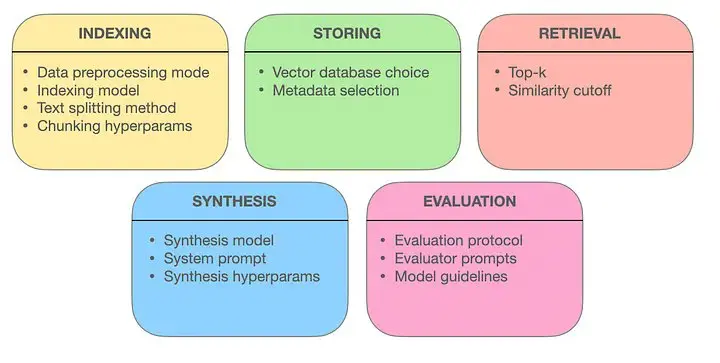
Design choices you need to build high-performing RAG systems, across 5 main pillars (ISRSE):

  1. Indexing: Embedding external data into a vector representation.
  2. Storing: Persisting the indexed embeddings in a database.
  3. Retrieval: Finding relevant pieces in the stored data.
  4. Synthesis: Generating answers to user queries.
  5. Evaluation: Quantifying how good the RAG system is.
 Designing RAGS  
Designing RAGs
[via](https://x.com/llama_index/status/1774240631231267285)

RAGs and Long Context LLMs

RAG for Long Context LLMs aka "Is RAG Really Dead" talk by Lance Martin of LangChainAI.

RAG Queries

LlamaParse

llama_parse  is an API created by LlamaIndex to efficiently parse and represent files for efficient retrieval and context augmentation using LlamaIndex frameworks. Notebook Example for an insurance document query. Product page with screenshots of how to use it.

Frameworks

Personal data

Hands-On RAG guide for personal data with Vespa and LLamaIndex | Vespa Blog

See also

To research

 RagOps  
RagOps
[via]()

References

  1. https://research.ibm.com/blog/retrieval-augmented-generation-RAG

notes#llm#rag

Llama Index

LlamaIndex is a flexible framework that enables LLM applications to ingest, structure, access, and retrieve private data sources. The end result is that your model's responses will be more relevant and context-specific.

Tools: Data Ingestion, Data Indexing and Query Interface

Data Ingestion from existing data soruces and data formats - PDF, Docs, SQL to use with a LLM.

Data Indexing Store and index your data for different use cases. Integrate with downstream vector store and database providers.

Query Interface accepts any input prompt over your data and returns a knowledge-augmented response.

Kinds of Applications that can be built with LlamaIndex:

  1. Documents Q&A
  2. Data Augmented chatbots
  3. Knowledge Agents
  4. Structured analytics -- Query structured data with natural language

Related:

notes#llm

Essays

This is an attempt to collect (slowly), essays that I can recommend.

Attention conservation notice: In the beginning, I will collect, later i'll curate.

AI

Situational Awareness ( PDF ); Also as website - situational-awareness.ai

self-improvement, and advice

What Should You Do with Your Life? Directions and Advice - Alexey Guzey. Jumping off point for other essays in the same milieu.

work

In praise of idleness by Bertrand Russell.

Culture

Collection of Essays

by others...

notes#essays

Activity Watch

ActivityWatch - Open-source time tracker runs on http://localhost:5600/

is an app that automatically tracks how you spend time on your devices. It is open source, privacy-first, cross-platform, and a great alternative to services like RescueTime, ManicTime, and WakaTime. It can be used to keep track of your productivity, time spent on different projects, bad screen habits, or just to understand how you spend your time.

TODO: An alfred plugin that will log what i'm doing into activitywatch using it's API. Has someone already done this?

notes#activitywatch#productivity#timetracking

scratchdb

ScratchDB

Via HN announcement:

ScratchDB provides two endpoints [1]: one to insert data and another to query. When you send any JSON, it automatically creates tables and columns based on the structure [2]. Because table creation is automated, you can just start sending data and the system will just work [3]. It also means you can use Scratch as any webhook destination without prior setup [4,5]. When you query, just pass SQL as a query param and it returns JSON.

It handles streaming and bulk loading data. When data is inserted, I append it to a file on disk, which is then bulk loaded into Clickhouse. The overall goal is for the platform to automatically handle managing shards and replicas.

The whole thing runs on regular servers. Hetzner has become our cloud of choice, along with Backblaze B2 and SQS. It is written in Go. From an architecture perspective I try to keep things simple - want folks to make economical use of their servers.

So far ScratchDB has ingested about 2 TB of data and 4,000 requests/second on about $100 worth of monthly server costs.  I built this because I was frustrated with how much work was required to run an OLAP database in prod: re-writing my app to do batch inserts, managing clusters and needing to look up special CREATE TABLE syntax every time I made a change. I found pricing for other warehouses confusing (what is a “credit” exactly?) and worried about getting capacity-planning wrong.

I was previously building accounting software for firms with millions of transactions. I desperately needed to move from Postgres to an OLAP database but didn’t know where to start. I eventually built abstractions around Clickhouse: My application code called an insert() function but in the background I had to stand up Kafka for streaming, bulk loading, DB drivers, Clickhouse configs, and manage schema changes.

This was all a big distraction when all I wanted was to save data and get it back. So I decided to build a better developer experience around it. The software is open-source: https://github.com/scratchdata/ScratchDB and and the paid offering is a hosted version: https://www.scratchdb.com/.

notes#database#scratchdb

typst

Introduction

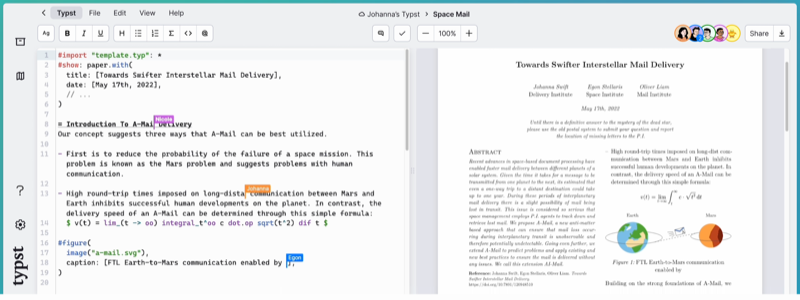
Typst is a modern typesetting language. See this post for a good intro to the topic -- Exploring Typst, a new typesetting system similar to LaTeX - jreyesr's blog; via. See Typst as a Language

Typst

Typst makes big strides; Sep 2026.

Pandoc

A New Typst Template for Pandoc

Example usage


Rheo? is an typesetting and static site engine for Typst.

See also: nota, latex, context, pandoc

notes#markdown#typesetting#typst

Home Automation

The midwit home from DYNOMIGHT INTERNET NEWSLETTER.

But perhaps there’s a third way. What if you try to achieve the goals of a smart home, but you rule out anything that involves getting two computers to talk to each other? So apps, phones, and hubs are out. But doorbells are good. Garage door openers are good. Dishwashers and smoke alarms are great. What else is there like that?

Quite a lot, arguably.

This approach is what I like.

notes#home-automation

Some selected Blogs

See btnews for my public feed aggregator; created in 2023H2, and haven't imported all the blogs I want to follow from my OPML feed


Not all of them may be active anymore...

General

Programming

  • Steve Yegge - Stevey's blog rants - classic programming blog -- some good posts include -- Emacs, Lisp, Kotlin, "the amazon post"
  • Paul Graham - not much about programming these days, but some vignettes back in the day, especially about "The Python Paradox", "Bayesian Spam Filters"
  • 2023-10-12 technically a blog | nicole@web, especially see In Defense of the Midwest

Science, and Mathematics

notes#blogging

Mistral AI

Mistral AI is is a European (French?) start-up with a global focus specialising in generative artificial intelligence. Mistral AI aims to develop new models of generative artificial intelligence for companies, combining scientific excellence, an open-source approach, and a socially responsible vision of technology.

Notes

If you're using Mistral, I'd suggest playing with @Teknium1's OpenHermes2.5 fine-tune. IMO the best 7B model out there. Together has it.

See more here

llama.cpp in server mode which uses mistral 7B GGUF. For all server calls add a field for custom grammar to get the answer in JSON.

ollama

Papers

The 7Billion parameter model which has outperformed the LLaMa2 from Meta - (Jiang et al. 2023)

References

  • Jiang, Sablayrolles, Mensch, Bamford, Chaplot, de las Casas, Bressand, Lengyel, Lample, Saulnier, Lavaud, Lachaux, Stock, Scao, Lavril, Wang, Lacroix, Sayed (2023). Mistral 7B.

notes#generative-ai#llm#mistralai

Random Forests

(Louppe 2015) is a PhD thesis by Gilles Louppe; implemented in scikit-learn

an in-depth analysis of random forests, consistently calling into question each and every part of the algorithm, in order to shed new light on its learning capabilities, inner workings and interpretability

we show that subsampling both samples and features simul- taneously provides on par performance while lowering at the same time the memory requirements. Overall this paradigm highlights an intriguing practical fact: there is often no need to build single mod- els over immensely large datasets. Good performance can often be achieved by building models on (very) small random parts of the data and then combining them all in an ensemble, thereby avoiding all practical burdens of making large data fit into memory.

References

notes#random-forests

Who does not want grade school level instruction in mother tongues?

  1. those who did not receive it themselves.
  2. those who associate an English education is the only way for everyone, especially their children to have a "good life"
  3. those who grew up at a time of severe resource crunch and the only way to get ahead was to get out.
  4. those who act like they do not belong to the land they live on.
  5. those who are only visiting and are here only temporarily

How can we address these?

notes

Notes on Algernon

Algernon is a webserver.

Using Lua Local Require

From the comments:

-- loadscriptdir.lua
local r = require
local pp = package.path
require = function(m)
    package.path = scriptdir() .. "/?.lua;" .. pp
    return r(m)
end

-- serverconf.lua
OnReady(function()
    require("loadscriptdir")
end)

TODO: I have to figure out if this works for loading .so files also.

Frictionless workflow to use algernon powered website

  • unless I want to compile a page and publish it, I don't need to run: make full.
  • run make easy as a cronjob on the server and have it publish to the www every 15 minutes
  • run make full as a cronjob on the server and have it publish to the www every hour

notes#webserver

Enemies of Productivity

  • I'll do it later
  • I'll start at HH:MM
  • Let me quickly do something other than what moves the needle
  • Do the work; nothing else.
  • "Turning up is half the battle/work". Where are you turning up to? Do you have a set place, a setting that gets you into work mode?

notes#gtd#productivity

Full Text Search

PostgreSQL

pg_bm25: Elastic-Quality Full Text Search Inside Postgres - ParadeDB

pg_bm25 is named after BM25, the algorithm used by modern search engines to calculate the relevance scores of search results

pg_bm25 aims to bridge the gap between the native capabilities of Postgres’ full text search and those of a specialized search engine like ElasticSearch. The goal is to eliminate the need to bring a cumbersome service like ElasticSearch into the data stack.

Built on top of Tantivy, a Rust-based alternative to the Apache Lucene search library

Support for fuzzy search, aggregations, highlighting, and relevance tuning

Relevance scoring uses BM25, the same algorithm used by ElasticSearch Real-time search — new data is immediately searchable without manual reindexing

notes#full-text-search

Kannada TTS and STT

STATUS: DRAFT

Deep Learning enabled, realistic sounding Text To Speech (TTS) and Speech To Text (STT) tools for Kannada.

There is a need for developing good, reliable, open-source TTS and STT solutions for Kannada.

Text to speech means converting a string into speech. There have been numerous advantages in TTS engines.

Speech to

Good outcomes

  • A free to use, offline working, high quality Kannada TTS voice for any project without onerous licesing. See Thorsten Voice (German) below.

References

  • Thorsten-Voice: A free to use, offline working, high quality german TTS voice should be available for every project without any license struggling. This can serve as a template/model for generating Kannada TTS voice.

notes

API Development

Reading

Everything I know about good API design by sean goedecke

Tools

The following should be considered as alternatives for Postman.

  1. bruno -- open source API client similar to Postman, Insomnia and similar tools. Bruno stores your collections directly in a folder on your filesystem. We use a plain text markup language, Bru, to save information about API requests.  You can use git or any version control of your choice to collaborate over your API collections.

  2. RapidAPI for Mac is a full-featured HTTP client that lets you test and describe the APIs you build or consume. It has a beautiful native macOS interface to compose requests, inspect server responses, generate client code and export API definitions.


dreamhead/moco: Easy Setup Stub Server

  • Write your own configuration file to describe your Moco server configuration as follow: (foo.json)
[
  {
    "response" :
      {
        "text" : "Hello, Moco"
      }
  }
]
  • Run Moco HTTP server with the configuration file.
java -jar moco-runner-<version>-standalone.jar http -p 12306 -c foo.json

notes#api

Coffee

The Case for Bad Coffee

I don't have memories of such bonding experiences taking place over a flat white at a Manhattan coffee shop or a $5 cup of nitro iced coffee at a Brooklyn cafe. High-end coffee doesn't usually lend itself to such moments. Instead, it's something to be fussed over and praised; you talk more about its origin and its roaster, its flavor notes and its brewing method than you talk to the person you're enjoying it with. Bad coffee is the stuff you make a full pot of on the weekends just in case some friends stop by. It's what you sip when you're alone at the mechanic's shop getting your oil change, thinking about where your life has taken you; what you nurse as you wait for a loved one to get through a tough surgery. It's the Sanka you share with an elderly great aunt while listening to her tell stories you've heard a thousand times before. Bad coffee is there for you. It is bottomless. It is perfect. via 2023-09-20

--

Kaveri Coffee sourced from Karnataka, sold in US; via opdroid1234.

Green Coffee, Unroasted Coffee Beans | Burman Coffee Traders via karatalaamalaka.

notes#coffee

xtts

Major Open Source Engine is Coqui. Others to consider -- Whisper, and Piper.

XTTS model weights from Coqui - coqui-ai/TTS: 🐸💬 - a deep learning toolkit for Text-to-Speech, battle-tested in research and production

KoljaB/RealtimeTTS: Converts text to speech in realtime by identifying sentence fragments for immediate auditory feedback. Ideal for applications requiring instant audio responses.

yl4579/StyleTTS2: StyleTTS 2: Towards Human-Level Text-to-Speech through Style Diffusion and Adversarial Training with Large Speech Language Models

Related to above: StyleTTS 2 | llm-tracker and a shootoff; via

vits -- via "model is 40M parameter and 150MB in size, and works on-CPU runtime"

(Kim et al. 2021)

It does its job for most on-device use cases like reading an article, practicing a language, etc.!! Here's how you can use it with Transformers !

Set up your environment: pip install transformers accelerate phonemizer

Initialize the model:

import torch
from transformers import VitsModel, AutoTokenizer
model = VitsModel.from_pretrained( "kakao-enterprise/vits-vctk") tokenizer = AutoTokenizer.from_pretrained( "kakao-enterprise/vits-vctk")
# Pass the text you'd like to synthesise:
text = "Hey, it's Max the best doggo speaking!"
inputs = tokenizer(text, return_tensors="pt")

# Generate audio
with torch. no_grad():
    output = model(**inputs).waveform[0]

Bonus: you'd soon be able to fine-tune them in your voice/ dataset too!

Indian language TTS

... specially i'm interested in SOTA, Open Source, widely available Kannada models. If not, there is an opportunity to develop one.

Indic TTS - Synthesis Docs github - AI4Bharat/Indic-TTS: Text-to-Speech for languages of India

Kannada (ಕನ್ನಡ) Text To Speech (TTS) Demo

Bhashini Neural TTS

2023-12-06 I have asked Mozilla Commonvoice to add Kannada Language Option.

Books

Speech and Language Processing -- by Dan Jurafsky and James H. Martin -- An Introduction to Natural Language Processing, Computational Linguistics, and Speech Recognition

Teams

References

notes#xtts

John Gray

Articles

James Lovelock remembered by John Gray | James Lovelock | The Guardian; archive.is

The experimental station was so called because Jim made most of his income throughout his life as an inventor. He was among the last in that tradition of Darwin and others, an independent scientist. He didn’t need a big organisation. He was part of that era where someone would call him up and say: “Look here, Lovelock, why don’t you try working on this for a while?”

Jim’s belief was that science should be used to achieve what he called a “sustainable retreat” from the Earth. That technology had to be used to diminish the human imprint on the planet, to allow the biosphere to be partially restored and rewilded.

Jim attributed his great old age to long daily walks – he lived to 103 and right up to the end his mind was very vivid. I joined him sometimes wandering through his grounds, where he’d let Gaia have its will.

 He certainly helped to shape the understanding in my book Straw Dogs that humans aren’t the centre even of life on Earth, let alone of the universe.

notes#person#philosophy

Small LLMs aka SLMs

Finetuning

(via)
  • unsloth is great if you are low on resources and want faster training, but it has some rough edges here and there and some things breaks in new releases. You have to dig into source code to know what changed. But it's a lot stable and better for the past few months. I used unsloth for finetuning qwen 2.5 vl at work for a pretty complicated task and it worked great for us. - trl + peft: this is more stable and unsloth uses most of the trainers from trl with their own patching, so similar APIs in both cases. - axolotl: this is great option if you want ready to go configs and don't have to deal with hand rolling code and provides easy distributed GPU support. -- via

LLMs that you can run on the desktop or a "regular(ish) PC".

A look at Apple’s new Transformer-powered predictive text model

the model being used by AppleSpell, an internal macOS application that checks for spelling and grammar mistakes as you type.

 found the predictive text model in /System/Library/LinguisticData/RequiredAssets_en.bundle/AssetData/en.lm/unilm.bundle. The bundle contains multiple Espresso model files that are used while typing (Espresso appears to be the internal name for the part of CoreML that runs inference on models).

  a set of 15,000 tokens in unilm.bundle/sp.dat that pretty clearly look like they form the vocabulary set for a large language model.

Read the rest of the above blog post to see how the tokenizer works, model architecture (GPT-2?) of about 34M parameters and hidden size of 512 units, which makes it smaller than GPT-2 models.


[2504.05299] SmolVLM: Redefining small and efficient multimodal models -- "Our smallest model, SmolVLM-256M, uses less than 1GB GPU memory during inference and outperforms the 300-times larger Idefics-80B model, despite an 18-month development gap. Our largest model, at 2.2B parameters, rivals state-of-the-art VLMs consuming twice the GPU memory. SmolVLM models extend beyond static images, demonstrating robust video comprehension capabilities."


Orca 2: Teaching Small Language Models How to Reason - Microsoft Research; see

M2 Max with 64GB RAM. It does ~50 tok/s on our q4 quantized 7b mistral fine-tune, with comparable speeds to GPT-4 via


moondream

moonbeam is a computer-vision model can answer real-world questions about images. It's tiny by today's models, with only 1.6B parameters. That enables it to run on a variety of devices, including mobile phones and edge devices.

Apache 2.0. You can use moondream for commercial purposes.

Applications:

  1. Security
  2. Drone and Robotics
  3. Retail and shopping --

Prem 1B and Prem 1B chat

  • apache 2.0 license
  • "Our goal is to create models that excel at RAG. Since RAG works by processing information at runtime, the main constraint is LLM size. For RAG, models don't need to be huge; they just need strong text comprehension to give accurate answers when provided with the right context."
  • blog post: SLM Journey Unveiled -- "In recent months, the landscape of language models has been enriched by the emergence of several small language models (e.g. TinyLlama, Phi2, Gemma, and StableLM2)"

Florence - a Microsoft Collection; SOTA 200M & 800M parameter vision foundation model. MIT Licensed!. 200M checkpoint beats Flamingo 80B (400x bigger model) by a huge margin. Performs captioning, object detection and segmentation, OCR, phrase grounding and more. Leverages FLD-5B dataset - 5.4 billion annotations across 126 million images. Multi task learning. Fine-tuned model checkpoints beat the likes of PaLI, PaLI-X.

"Florence2 200M, Qwen2 500M, MSFT InstructLM 500M With little fine-tuning they unlock so many creative and on-device use cases" via


Fine-tune Llama-3-8B with Llama-3-405B synthetic data

A simple notebook for fine-tuning a small model (Llama-3-8B) to be an expert in a specific domain, by letting a larger, more capable model (Llama-3-405B) teach it (by generating synthetic dataset for that domain).

--

nisten/Biggie-SmoLlm-0.15B-Base · Hugging Face via

--

AMD Unveils Its First Small Language Model AMD-135... - AMD Community

--

Marlin 2B -- a tiny VLM to extract structured information from videos Marlin is finetuned for two questions devs want to ask in their videos: what is happening, and when?

Papers

(Belcak et al. 2025)

we lay out the position that small language models (SLMs) are sufficiently powerful, inherently more suitable, and necessarily more economical for many invocations in agentic systems, and are therefore the future of agentic AI. Our argumentation is grounded in the current level of capabilities exhibited by SLMs, the common architectures of agentic systems, and the economy of LM deployment. We further argue that in situations where general-purpose conversational abilities are essential, heterogeneous agentic systems (i.e., agents invoking multiple different models) are the natural choice. We discuss the potential barriers for the adoption of SLMs in agentic systems and outline a general LLM-to-SLM agent conversion algorithm.

(Su et al. 2025)

Just an 8B model trained on calling tools and other LLMs to answer queries It's a great demo of what frontier SLMs will be about in 2026

MacOS desktop

Phone

  • "phi-3-mini, a 3.8 billion parameter language model trained on 3.3 trillion tokens, whose overall performance, as measured by both academic benchmarks and internal testing, rivals that of models such as Mixtral 8x7B and GPT-3.5 (e.g., phi-3-mini achieves 69% on MMLU and 8.38 on MT-bench), despite being small enough to be deployed on a phone." (Abdin et al. 2024). (No code, or model was announced with the paper).

aiOS™ by Hyperspace "Organizing the World's AI Agents. Join the world's largest peer-to-peer AI network and start earning points"

References

notes#llm#slm#smol-llm

Unfinished Projects

I should ideally start any and all new projects here so that I can keep track of what I've started and yet unfinished. Inspired by main.horse (who talks about "unfinished plans", slightly different, but a good idea worth stealing).

See yakshaves for ideas that are in germination (I should probably use that only for tracking tech/code/hack projects).

Also, it is better to finish the projects -- The Art of Finishing | ByteDrum

Ideas

Ramayana Manga

It would be a nice art project to make a print comic book (manga?) using the stills from the Japanese anime film "Ramayana: The legend of Prince Rama". Originally from my tweet

In progress

  1. pandaku; 2024-04-20--
  2. nother; 2024-10-10--
  3. Cardamom

Completed

  1. Semantic CSS for Pandoc;

Abandoned

  1. Secure Scripts; 2023-08-01--2024-07-28

Ideation

  1. Feasibility Study of Market Garden in Rural Bengaluru
  2. Make a visual catalog of Kannada books, audio-tapes, movie posters. Inspired by joodaloop starterpack; 2024-03-06

See Old Projects(pre-2012)

notes#projects

Compressing well is related to intelligence

Hutter Prize -- 500'000€ Prize for Compressing Human Knowledge sponsored by Marcus Hutter

This compression contest is motivated by the fact that being able to compress well is closely related to acting intelligently, thus reducing the slippery concept of intelligence to hard file size numbers. In order to compress data, one has to find regularities in them, which is intrinsically difficult (many researchers live from analyzing data and finding compact models). So compressors beating the current "dumb" compressors need to be smart(er).

References

notes#competition#computer-science#intelligence

Local First Development

Some notes on Local-First Development

Show HN: ElectricSQL, Postgres to SQLite active-active sync for local-first apps

It's an open source, local-first sync layer that can be used to build reactive, realtime, offline-capable apps directly on Postgres with two way active-active sync to SQLite (including with WASM in the browser).

Electric comprises a sync layer (built with Elixir) placed in front of your Postgres database and a type safe client that allows you to bidirectionally sync data from your Postgres to local SQLite databases. This sync is CRDT-based, resilient to conflicting edits from multiple nodes at the same time, and works after being offline for extended periods.

Some good links to get started:


Local-first software: You own your data, in spite of the cloud article by Ink and Switch.

A Local-First Case Study | jakelazaroff.com, where Jake talks about the story behind Waypoint, a local-first web app for planning trips; it takes inspiration from Ink and Switch's Embark; via HN.

Local-First Software special interest group; they have youtube videos of their meetups.

notes#local-first-development

Segment Anything Model

Segment Anything -- The Segment Anything Model (SAM) produces high quality object masks from input prompts such as points or boxes, and it can be used to generate masks for all objects in an image. It has been trained on a dataset of 11 million images and 1.1 billion masks, and has strong zero-shot performance on a variety of segmentation tasks.

YavorGIvanov/sam.cpp -- Inference of Meta's SAM in pure C/C++

See also: ggml

notes#ai#generative-ai