Course notes from Building Multimodal Search and RAG about Multimodal Learning.
- Instructor: Sebastian Witalec, head of developer relations at Weaviate,
- human's learn multi-modally
- human's foundational knowledge is built using multi-modal interaction with the world and not via language.
- multi-modal embedding models produce a joint embedding space that understand all your modalities (e.g.: text, video, audio, picture).
- Training:
- start with specialist models
- unify these models
- the vectors that they generate are going to be similar
- Models are unified using a process called contrastive representative learning.
- CRL is a general purpose process that can be used to train any embedding model.
- create one unified vector space representation for multiple modalities
- by giving positive and negative examples, we train the models to pull closer vectors together for similar examples. and push away dissimilar examples
- Anchor point
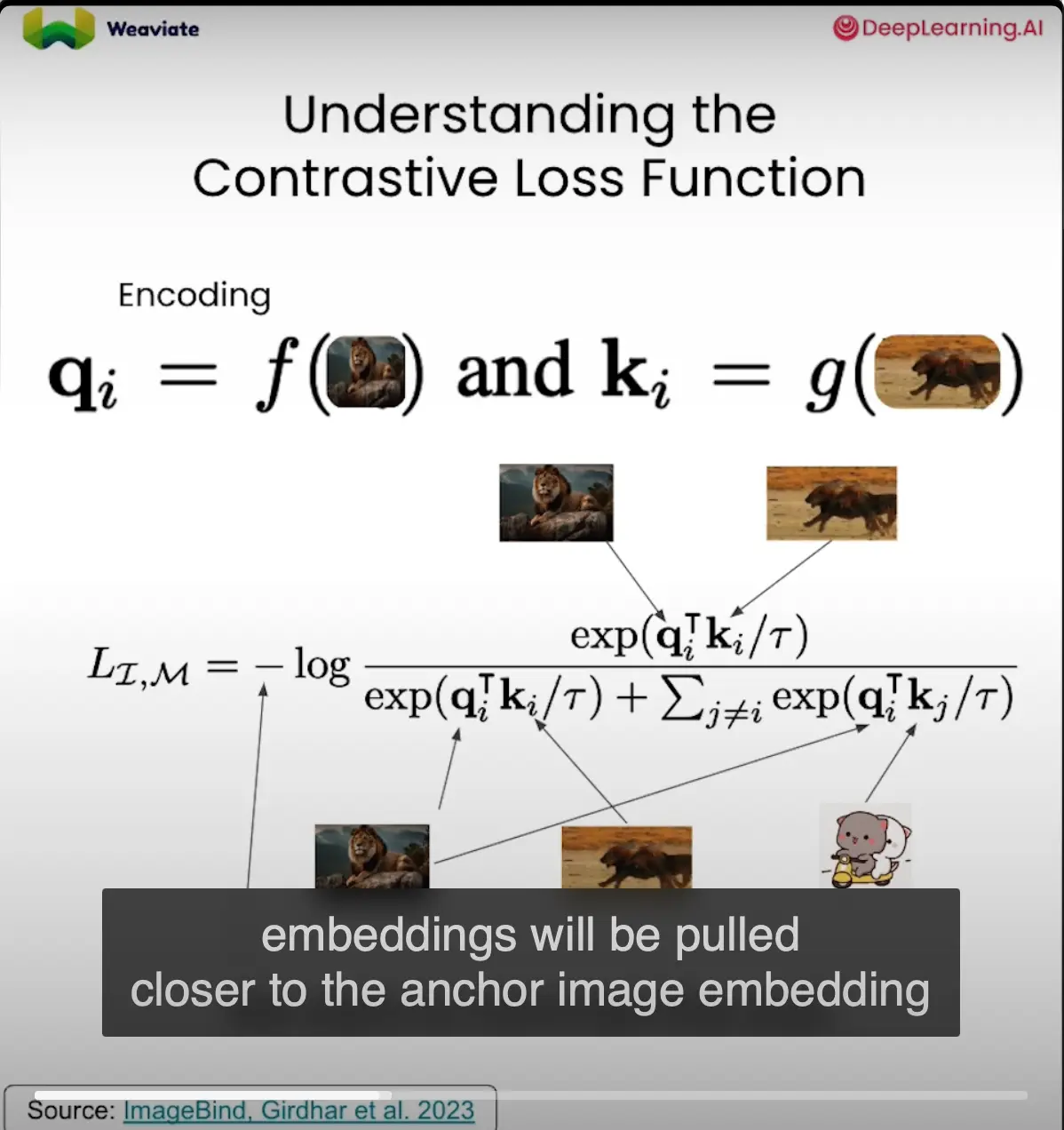
- The pushing pulling process is achieved with the contrastive loss function.
- encode the anchor and the (+ve and -ve ) examples into vector embeddings.
- calculate the distance between the anchor and the examples.
- minimize the distance between the positive example and maximize the negative example during the training process.
- in multimodal learning, the examples can be from different modalities.
- Minimize the loss... (Girdhar et al. 2023)
References
- Girdhar, El-Nouby, Liu, Singh, Alwala, Joulin, Misra (2023). Imagebind: One Embedding Space to Bind Them All.